Thursday, May 02, 2019

Spotlight on Engineering Team Building: Lessons learned from Algolia


Team building is top of mind for any start-up founder or exec. Recruiting and retaining top talent is even more challenging for software engineers.

To get an insight into how successful start-ups approach team building, we spoke to Sylvain Utard, employee number 1 and VP of Engineering at Algolia, an Accel portfolio company. Algolia is transforming the search and discovery experience that businesses can offer their users online, managing over 50+ billion search queries a month for enterprise customers including WeWork, Zendesk, Twitch and Stripe. Algolia has been doubling YoY since we invested in 2015 and has now more than 300 people, including 90 engineers.

We asked Sylvain to share his secret tips with us.

How do you attract talent as an enterprise start-up?

Sylvain: Because we don’t have the visibility of a consumer brand or a well-established enterprise company, we focus on what differentiates us. The first is culture. From the very beginning, our founders Nicolas and Julien talked about building a culture-first company, and for us it provides a way to both attract and assess candidates. 

The second is to demonstrate the reach of the product. Almost all of the tools, especially technical ones, that engineers use are customers of Algolia. That is a very powerful statement.

How do we get these messages across? We make sure the hiring managers are involved in the entire recruitment process, from sourcing candidates and selling the company. Not only does it ensure that we get across what the company is about in an authentic way, it also gives our teams visibility and input into the process.

In parallel, it is essential to tap into the widest possible talent pool. Many prevalent recruitment tools, including LinkedIn, tend to produce a pipeline of mostly male candidates - our experience is that the response rate is 40-60% among men, compared to 10% with women. We work to broaden our reach, through initiatives including meetups for female developers at our offices and pro-active reach-out to women. We also over-hauled the language used in job specs and other communication to remove typical male tech stereotype words such as free beer and a desire to hire “ninja’s”.

What are your top tips for assessing technical competence?

Sylvain: For entry level engineers this is quite straightforward and includes both technical interviews and home assignments. We’ll also want to look at someone’s previous work, and what they’ve been posting on GitHub (or Dribble for designers).

With manager level candidates, it’s important to recognise that they may have become one step removed from development work. To compensate, we ask them to conduct a mock interview, as if they are themselves interviewing a prospective new member of the team. This gives us a good impression of both their own technical knowledge, and how they would assess and coach that of others.

Retention is a big challenge for every growth company. What’s your approach to extending the life-cycle of your engineering team?

Sylvain: Onboarding is a crucial part of turning a good hire into a great team member. At Algolia, it includes sales call shadowing (because engineers need to understand how to sell the product, as well as build it) and a specific project that will be completed in the first 2-3 weeks, giving new hires an early opportunity to demonstrate their skills.

You also need to show people how they can grow their career at your company. This is best achieved by pushing decision-making power down the hierarchy, to keep your rising stars challenged and motivated.

Today’s talent expect flexibility and as a company you need to be responsive. In developing our remote working policy, we have spent a lot of time thinking about everything from the communications tools we use (no more whiteboards!) to the question of how client data will be accessed. Because our product is reasonably complex and requiring a good level of support, we find it beneficial to have people working closely together at least some of the time.

There has to be acceptance that retention is never total, however; People will eventually leave, and that doesn’t necessarily mean your system is at fault.

Finally, what’s your approach to team structure and management?  

Sylvain: Your teams need to change as your company does. We now operate a squad model, where our engineers are grouped into smaller teams dedicated to one specific task. There are currently over 20 squads, across products and focus areas from APIs to analytics. This model gives you focus, but you also need to work on connectivity between squads, for times when you want to make horizontal improvements across the entire product range.

Over time we’ve also come to recognise the importance of having enough management layers in place. At one point, I was line-managing 25 engineers and it became clear we needed an engineering manager to help the teams prioritise tasks and maximise productivity. At this stage, your role as the manager’s manager becomes important, offering a sounding board and helping them to learn and evolve in their role.

************

Thank you, Sylvain, for sharing your wisdom. Building a great team is something that requires care and precision at every stage, but it is worth every minute invested. It is one of the most important success factors for a start-up. 


Tuesday, February 12, 2019

Meet Chainalysis, the startup that brought down the biggest dark web marketplace


This post was written with my colleague Amit Kumar. We worked closely together on this exciting new investment.
 
*****************
 
While still very much in its infancy when it comes to development and adoption, a decentralized financial system has the ability to be massively disruptive and important for decades to come. However, in order for cryptocurrency to achieve this potential and for the industry to mature, there is a growing need for foundational infrastructure and regulatory frameworks to drive compliance and transparency between all stakeholders.
 
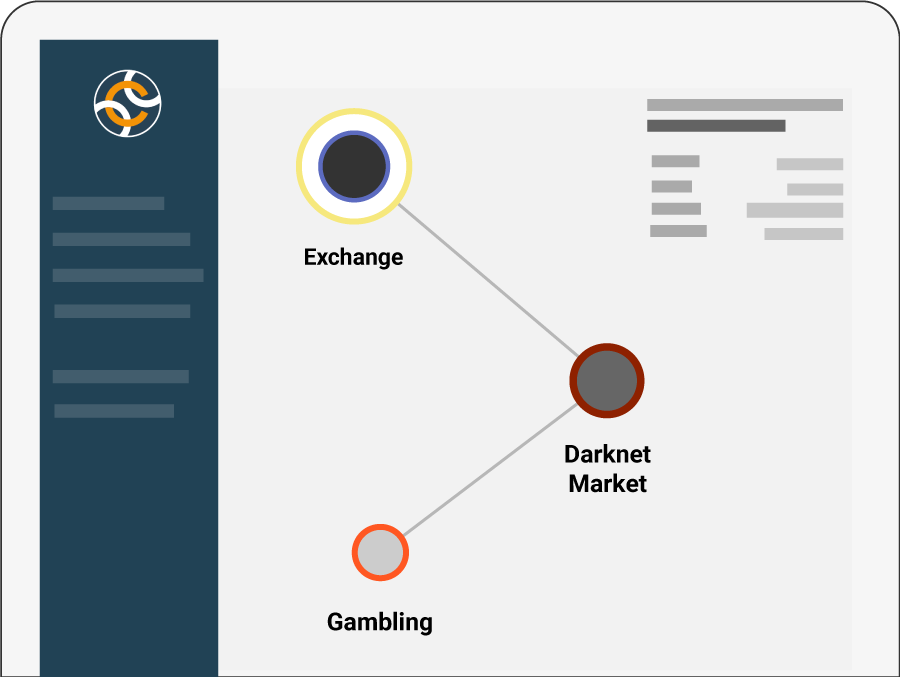
This is why we’re so excited to announce our investment in Chainalysis, a company that uniquely leverages deep analytics and machine learning to help law enforcement agencies track illicit crypto transactions and financial institutions comply with anti-money laundering rules — important pillars towards the inevitable maturation of the cryptocurrency space.

Chainalysis is the clear market leader in their vertical and sits at the nexus between crypto exchanges, financial institutions, regulatory bodies, and law enforcement agencies. They’ve earned this position by their incredible work and track record over the last few years helping law enforcement agencies cope with the rise of this new technology.

While there’s been a number of highly publicized examples including their role in helping creditors of Mt. Gox track down hundreds of thousands of Bitcoins to the Dutch police crediting the company with helping them find Hansa, one of the world’s biggest dark web drug marketplaces, to the company’s more recent Crypto Crime Series published earlier this year, much of the work that they do remains behind-the-scenes, but is no less critical.

Technology innovation outpacing governments’ and regulatory bodies’ ability to adapt isn’t a new tale; we’ve seen it play out across many different industries in Silicon Valley. And it requires an exceptionally thoughtful, committed team working diligently to close this gap. Michael, Jonathan and Jan have done just that and have quietly assembled one of the very best teams in the space across their offices in Copenhagen, London and New York . We believe deeply in Chainalysis’s mission and couldn’t be more thrilled to help accelerate the deeply critical work that they are doing to bring cryptocurrencies closer to mainstream.


Tuesday, September 18, 2018

Vision and Grit: How Peopledoc defined a multi-billion HR Software category


On July 17, Ultimate Software, a $10B HR software gorilla, announced the acquisition of Peopledoc for $300m - the largest software exit in France since the acquisition of Neolane by Adobe in 2013. Hats off to Jon Benhamou and Clement Buyse, the two founders, and to the wider Peopledoc team for this achievement!

Sometimes companies get to the point of acquisition in a straight line; most of the time, however, they don’t. It’s only the perseverance, grit and vision of the founders that makes it possible. Peopledoc is a great example, and the success of the company is deeply entrenched in the driving force of the founding team, who reinvented the business a couple of times to get to where they are today. This took foresight, courage, creativity and a lot of hard work. Let’s jump back to 2007 to see where it all began…
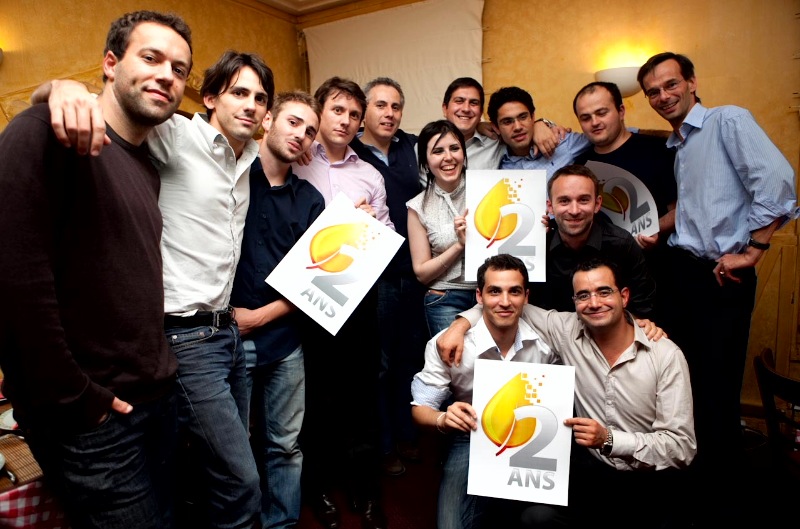
Celebrating Year 2
In a dark dorm room on the HEC (the French HBS) campus, Jon and Clement were scratching their heads in search of the business idea to present for their entrepreneurship major. They were lucky to have Pierre Kosciusko-Morizet, founder of PriceMinister, and Jean-David Chamboredon, founder of ISAI, as their mentors. The four of them hatched their first idea: creating an online document management system for utility e-bills, which were starting to take off in France. When John and Clement graduated a few months later, and with the angel funding of Pierre and other friends, they started their first company, Novapost. Unfortunately, the level of adoption was not quite what it needed to be and in 2010, the team realised that a new strategy was needed. Given how hard it was to digitize paper for consumers, they decided to focus on the enterprise market.
Jon and Pierre working on the first business plan in 2007
 
A few brainstorming sessions later, and a new strategy was born. Jon and Clement decided to leverage their online document management platform to digitize payslips, reinventing the company for the first time. In France, the law mandates that companies provide employees with access to their payslips (as proof for retirement benefits) for 50 years, and this requires a layer of security and compliance that legacy document management companies didn’t provide.

Team first attempt at marketing Novapost: "Save like pigs"
In June 2010, Jon and Clement relaunched the company as a new HR SaaS business with a €1.3m Series A investment from Alven and Kernel (Pierre’s investment fund). In October 2012, as the business started to take off, I received an email from Pierre: “The company is killing it, not raising for now but it’s worth you meeting with the CEO.”

Lunch was set, and it was a great lunch. I loved Jon’s energy and drive and his exceptional ability to inspire people to share his dreams. As we discussed the potential of the market, I suggested him to expand the product platform to address markets beyond France. French payslips were an interesting market, but somewhat limited in size.

Fast forward to spring 2013, and I caught up with Jon, who told me that they were launching a new product: Peopledoc – a full document management platform for HR. A much bigger market. We discussed the opportunity to go global and start by setting up a beachhead in the US. A month later, Jon let me know that the day after our call, he had gone to the US embassy to apply for a visa and was moving to New York in September.
Jon and Clement with French President Francois Hollande
in the new Peopledoc New York office
 
I was impressed by how decisive Jon and Clement had been on such an important decision. So, a few months later, when Jon called, I jumped at the chance to invest, and we closed the $17.5m Series B in May 2014. At the same time, the company rebranded as Peopledoc, understanding that their new product was their biggest asset, for its second reinvention.

When we invested, Peopledoc was at a $3m run rate, with an exciting and challenging journey ahead! The gross margin of the company was sub-40% and needed to reach over 70% to become a “real SaaS” business. During the fundraising process, Jon, Clement and I had several strategy discussions on what it would take to build a massive SaaS HR business:
  • First, we needed to conquer the US market: get our first references fast and build a strong sales team locally.
  • Second, we needed to shift the company’s product mix from payslips to document management. Payslips were a managed service business, and while 50% of payslips were digital, 50% were still paper.
  • Third, we needed to add new modules to the platform, beyond document management, to create a new HR software category.
Shortly after the closing of the round, we brought onboard Mike Dinsdale, the CFO of DocuSign, as an independent board member. From there, the stars continued to align, as we addressed each challenge. Jon and Clement hired several key US execs in sales, marketing and finance, which helped land the first $500k ARR deal with a flagship US financial services firm in 2015. The product mix shifted over time as the company expanded in the US, UK and Germany and finally, the team launched HR case management and digital onboarding. New competitors started to address the market, such as SuccessFactors and ServiceNow, and Gartner recognised the category as “HR Service Delivery”.

In the midst of this, Eurazeo led the $28m Series C.

By mid-2018, the team had grown to 240 people in the US, UK, Germany and France, gross margin had skyrocketed to 75%+ and the business was growing 100%+, with a $30m+ run rate.

 And then Ultimate knocked at the door, which gave us a very hard decision to make. More than 10 years had passed since the first late nights in the university dorm. The business model had evolved three times, and the company went from a Paris based start-up to a global HR category leader headquartered in New York. For Jon and Clement, it was a good time to give new wings to the company and write its next chapter.
 
Jon and Clement announcing the deal with Scott Scherr, CEO of Ultimate
 
I feel privileged to have been part of this story and will miss our board meetings. Congrats again Jon and Clement for showing true vision and grit! What an exciting journey.

Monday, June 18, 2018

Building Workflows should be easy - and they will be...with Zenaton!


This blog post was co-authored with Adrian Colyer, Venture Partner and former CTO of Pivotal
 
Nearly all businesses have process-related workflows that govern how their users interact with their service or automate internal tasks...and they are painful to code and even more painful to test. Hopefully things will change soon with Zenaton, the newest addition to the Accel family. We are joined in this seed round by our friends at Point9.
For instance, let’s suppose, in the light of the GDPR legislation a company wants to send a series of emails over a period of a few weeks, reminding people to explicitly opt-in to receive communications, so it can record their consent. Obviously, the emails should stop if consent is given at any point in time. In many cases the implementation will involve database changes, scheduled tasks, and cumbersome logic to tie it all together. What should be a simple workflow ends up creating a mess!
There are software applications, or workflow engines, that have been created to manage business processes. So, why does this happen? Because many existing workflow engines are hard to use, and it's easier for a developer to hack something together themselves. After experiencing this issue many times over, the Zenaton team - Louis Cibot and Gilles Barbier - had had enough. They built a workflow service designed to delight developers with a simple and easy to use API. It's just way easier to code a workflow using Zenaton than it is to roll your own, and when it comes to developers, ease of use is incredibly important.
As we got to know Zenaton, we spoke with many companies whose teams who were extremely pleased with the simplification in their codebases and the speed with which they could make progress: focusing on their business processes, and not on the intricacies of long-running asynchronous workflow management. You'd have to prize Zenaton out of their cold dead hands before they'd give up on this kind of improvement.
With Zenaton, the code looks like the design. The implementation of the workflow is all in one place, with a straightforward mapping to the business process. The Zenaton service orchestrates the workflow for you, invoking the individual flow steps as tasks that run within your own environment.

None of that counts for anything of course if the backend workflow engine isn't up to scratch. The Zenaton team have spent a lot of effort on this and have built a robust platform on top of the Erlang Virtual Machine, well known for running distributed and fault-tolerant systems (Erlang is a programming language used to build massively scalable soft real-time systems with high availability requirements). It's all made available as a scalable service so there are no setup costs, and no operational overheads.
Zenaton is currently in closed beta and will launch in the coming weeks. It has clients for Node and PHP, with Python, Ruby, and Java in the works.
We believe that any developer who wants to spend more time working on business features and less time solving purely technical issues will love Zenaton. We are excited to back Gilles and Louis, as they roll out their platform and put it into the hands of developers around the world. We are big believers in massive growth of dev tools and the API economy and see Zenaton in the continuity of previous Accel investments like Atlassian, Algolia and Segment.

Friday, April 27, 2018

Signed, sealed, delivered: DocuSign hits the Nasdaq


Congratulations to the past and present DocuSign team for their incredible achievements, as the company makes its public market debut. What a journey it has been since the genesis of the company in 2003, when it’s visionary team set out to automate the agreement process and solve many pain points from speed to cost and accuracy.

In 15 years, DocuSign’s cloud-based platform has made it possible for more than 370,000 companies and hundreds of millions of users to make nearly every agreement, approval process, or transaction digital—from practically any device, virtually anywhere in the world. It’s rare to see any type of technology reach such a range of customers -  from very large companies to individual users across all industries. Today, seven of the top 10 global technology companies, 18 of the top 20 global pharmaceutical companies, and 10 of the top 15 global financial services companies are DocuSign customers. More than 700 million transactions have been performed on the platform. And this is just the beginning!


DocuSign’s second office, the ‘Garage’ 

From printer & fax to computer
When Tom Gonser, Court Lorenzini and Eric Ranft started the company in 2003 out of Seattle in the overhang of the dot.com explosion, the business world was used to the print-sign-fax routine. I’m sure everyone still remembers those moments of anxiety in a random hotel lobby, trying to email a document to the reception desk so they could print it for signature… a frustrating process which could easily take an hour. There had to be a better way to do this and indeed there was: DocuSign was born and suddenly the print-sign-fax routine became as simple as connecting to a Wi-Fi network. One click and the document was securely signed and authenticated. But, you still needed a computer and a Wi-Fi connection to do this.

From computer to iPad
In the company’s early years, the notion of an e-signature first gained traction in the midmarket and in particular in the real estate industry. Real estate brokers quickly realised the value that could be gained from an expedited signature process. With the launch of 3G and the rapid growth of iPhones and iPads in 2007-09, the world realised that paper could be entirely digital, beginning a new era for DocuSign, which had invested early on in “mobilising” its product. Executing a transaction became as simple as a tap on your tablet or smartphone, further fuelling the company’s growth.

From e-signature to digital transactions
With large enterprises beginning to adopt the technology, the platform quickly evolved in several dimensions. With the first global enterprise-wide deployments, the team strengthened the scalability, security and certifications of the platform. A lot of people still see e-signature as a simple problem to solve (as easy as a tap on a mobile screen), but this is only the tip of the iceberg. There is a lot more to it to ensure the authentication of the user, the security of the information, and the management of the transaction workflow.

Partners network
Keith Krach, who joined the board of the company in January 2010, was appointed CEO the following year. During his tenure from 2011 to 2017, Keith developed a set of partnerships with most of the relevant leaders involved in software productivity and transactions, including Microsoft, SAP, Salesforce and Comcast. These deals strengthened the footprint of DocuSign, reinforcing the company’s position in the industry.

A DocuSign sales meeting in early 2016 

It is all about people
Having the chance to work with the leaders who made this success story happen has been a privilege for us. This stellar team includes Tom Gonser, the co-founder of the company and driving force behind the product and vision; Keith Krach, who I had the chance to know before his involvement with DocuSign; Mike Dinsdale, who I knew from his days at Lithium in 2009, and who became CFO of DocuSign in 2010 (and is now the CFO of Gusto). Mike and I regularly exchanged thoughts on SaaS metrics and strategic transactions in EMEA. And last but not least, Dan Springer, a long-time friend of Accel through our investment in Responsys, who became CEO last year.

What a journey – hearing the bell ring this morning brought all of these wonderful memories back. It reminded me that at the end of the day, the journey is the reward. Thank you again to all the members of the DocuSign family!

Tuesday, December 12, 2017

3 tips to check that your salesforce is ready to scale


Earlier this fall, we co-organised with Salesforce Ventures the first edition of Cloud Europe, a ½ day event preceding SaaStock 2017 and gathering the founders of the top 100 European SaaS companies. We were lucky to have as a keynote Chris Ciauri, EVP Salesforce EMEA, and he shared a few tips to check that your sales organisation is ready to scale. Here is a quick summary of the key insights with us, which hopefully will help you with your 2018 planning.

1)     Balance your sales management ratios

As software companies scale, the question of span of control in the organisation becomes critical. There is no right or wrong answer and it will depends on your business. But here is what has worked well for Salesforce and is a good starting point for a SaaS business:

·       4-5 first line managers to 1 second line manager

·       6-10 reps per first line manager. 6-10 reps is a wide range: the right ratio will depend on the segment. For small businesses, the number will be closer to 10 and for enterprise, closer to 6


2)     Figure the right formula for your sales support functions

For most SaaS companies, sales reps will be supported typically by Solutions Engineers (SEs) and by Business Development Reps (BDRs) who are cold calling and taking appointments. To be able to scale quickly, each company should figure out the right ratios of these support functions vs. sales reps. The formula will be heavily dependent of the customer segment targeted. Here is the rule of thumb that Salesforce has used successfully:

 
3)     Build your Sales Academy

Sales and acquisition costs are typically heavily represented on the cost base of SaaS companies and having a short ramp-up time for your new sales hires is a key lever to increase the overall productivity of your organisation. Here are the four key pillars that Salesforce has used to set-up an effective Sales Academy:

·       Send your new hires pre-work: You want your new hires to have a basic understanding of your product functions and differentiation. Send the sales pitch, product sheets and competitive overview to new hires in advance. It is a good step to get them started on the right foot.

·       Develop your sales bootcamp: Stack your hiring to make sure a critical mass of new sales people will start on a given Monday and prepare a bootcamp over several days to get them familiar with the company product and teams. It is helpful for example to have them attend support calls, get an overview of the product roapmap from the product team, shadow experienced reps and, of course, learn the tips from the top people on the team.

·       Prepare a 30-60-90 day achievement plan: The first three months are critical to ramp your reps and it helps to have specific goals each month to measure progress. It also gives them something to aim for, especially in businesses where the first customer close can take time.

·       Don’t forget the badges: as your reps will progress in their tenure, it is effective to attribute badges based on specific achievements. It helps boost morale and competitiveness in the team, when all reps cannot be in the President’s club

At the end of his presentation, Chris gave us a final piece of advice: each month counts! Manage your sales and pipeline on a monthly basis (or try to!), even if you have quarterly closings. Fast cadence is everything in sales!

And good luck to close your Q4!

Tuesday, September 19, 2017

Cloud Europe 2017: The Factory is Cranking

Recent SaaS trends and the Accel Euroscape of the 100 most promising companies in Europe and Israel

************
This article was co-authored with my colleague Pia d'Iribarne and published initially on Tech.eu. Findings were presented at Cloud Europe, an Accel and Salesforce event gathering the top 100 SaaS companies in Europe, in conjunction with SaaStock 2017. You can see the full presentation here -

************
Europe is fertile ground for Software-as-a-Service (SaaS) companies, as shown in our comprehensive look at SaaS last year, “SaaS Wars – Europe Awakens”. Since then, momentum has only accelerated, and we’ve published a fresh edition of the top 100 European SaaS companies in conjunction with SaaStock 2017.

But, first, let’s take a look at the overall health of the SaaS industry.

12 cloud IPOs in the past 2 years: One from Europe 

SaaS companies are thriving in the public markets, with their aggregated market cap grew 350% since 2011, and 12 cloud companies going public in the past 24 months. These 12 have performed well, with an aggregate $2.6 billion in revenues (growing 39% year-on-year) and $25B of market cap. Compared to Salesforce, the industry leader, the stats were not too dissimilar over the same period: its market cap grew by $19B and its revenue increased by $3.3B.

Looking closer at the 12 companies, we can conclude that it takes a $100m+ revenue run rate and 30-50% growth to go public in the current environment, even if several companies like Atlassian and Cloudera waited to reach $300M+ revenues before going public. However, the companies’ annualised free cash flow showed a big variation, ranging from -$100M for Box and Cloudera to +$100M for Atlasssian.


 Out of the 12 IPOs, Mimecast is the only company from Europe. However, as Europe’s SaaS acceleration began in 2013, and given that the median time to IPO from this group is 10 years, it will take time before we see a meaningful geographical change in SaaS IPOs. 

A healthy funding environment and momentum in Europe 

Like the public market, the private funding environment is still at an all-time high in 2017 with an annualised investment rate of $8.4B in the US, $2.6B in Europe and $0.9B in India. Europe and India are growing particularly quickly, and investment more than doubled from 2015, while the US is up 20%. 

The pace of SaaS company creation in Europe is growing even faster, up from 200 companies in 2008-10 to 670 in 2014-16. Our investments in the space have followed suit. We’ve invested $2.3B in SaaS companies globally. In 2010, 4% of this funding was going to European SaaS companies, while it’s over 40% this year.

With a more mature SaaS market and more late stage companies, the US is posting record late stage funding rounds with Dropbox raising $600M, Slack $200M and Qualtrics $180M in the past 18 months. Funding in Europe is healthy but reflects the market’s earlier stage. The largest rounds include Algolia with $53M, Collibra and Showpad with $50M each and CallSign with $35M.

The Accel Euroscape

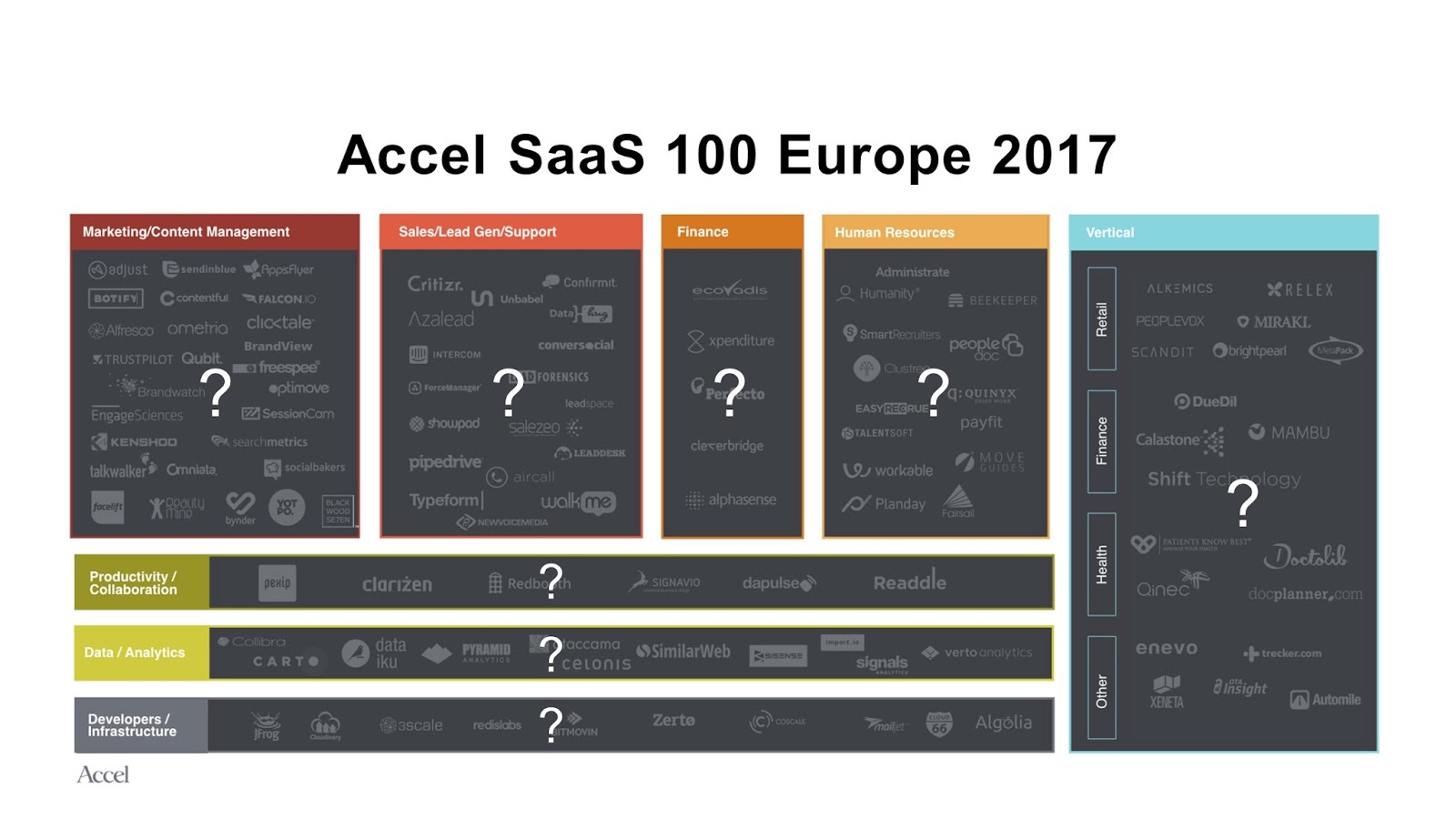
With a positive environment fuelling the market, this year we extended our research for the Accel Euroscape, the 100 most promising SaaS companies, to look at over 1,000 companies across 12 countries and included a new category, Security:


Note: to create the list, we ranked each company by a set of criteria including market attractiveness, level of technology differentiation, strength of the team and initial traction (monthly recurring revenues and growth in number of employees). Nothing is perfect, and we might have missed some great companies. Your feedback is welcome!

Overall, these 100 companies illustrate how the European market is maturing. They have raised $3.4B in total, of which $1.8B or 53% was in the last two years alone. Close to 60% of them have raised more than $15M, and 22% have raised more than $50M, including Algolia, Collibra, Doctolib, Qubit and Showpad. From a revenue standpoint, 58 companies have already crossed the $5M per year mark and 29 are $15M+.

From a geographic standpoint, the UK and Israel lead the pack with 20 companies each, followed by France with 18 and Germany with 8. The remaining companies are fragmented across Europe, showing that great SaaS companies can emerge from any city on the continent. From a funding perspective, Israeli companies have raised on average more than their British (-48%) and French (-160%) counterparts at similar stages. 

Comparing the list to the top 300 leading SaaS companies in the US, some interesting trends emerge:
  • Europe is showing strength in data/ analytics and security, driven by the booming ecosystem in Israel but is less represented in developer/infrastructure and vertical applications.
  • The EU/US funding gap still exists, especially at the seed stage ($1-2M raised on average in Europe vs. $5M in the US) and series B ($20M raised on average in Europe vs. $37M in the US).
  • In terms of funding efficiency, leading European companies appear to be more efficient than their US counterparts. We looked at capital required to reach $10M Annual Recurring Revenue and saw that European companies required $7-15M to get there while US companies required $15-20m.
  • In addition, fast-growing US and European companies are reaching $10M in revenue in similar time periods. Whether Algolia or Twilio and Duetto or Doctolib, they took 1-2 years.
EU Companies: Blue Lines - US Companies: Black Lines

Crystal ball: What the future holds

With the European SaaS landscape moving fast, we’ll continue to see it evolve and believe there are five trends that will define the next crop of fast growing SaaS businesses:

  1. AI and Automation-driven productivity: The next generation of AI-driven technologies to improve backend processes is now coming of age, and is seeing fast adoption from Fortune 500 companies redesigning their processes. Large System Integrators are developing dedicated practices to drive this change. Promising companies in this segment include Robotic Process Automation vendor UI Path and process mining software startup Celonis.

  2. The rise of the SMB engine: The past few years have demonstrated that companies focusing on the SMB segment can become very valuable businesses – both as public companies, with Shopify reaching $10B market cap and Xero, Wix and Hubspot in the $2-3B range, or through M&A, with Netsuite acquired for $9.3B, Constant Contact for $1.1B and Intacct for $0.85B.

  3. APIs and Microservices-driven infrastructure: Given the increasing need for agility and scalability, micro-services and APIs are taking over infrastructure, and we can expect more companies to emerge in this area, providing API-driven functionality (like hosted search engine API Algolia) or helping to manage this next generation of infrastructure (like Application Performance Management solution Instana).

  4. Vertical applications: With the SaaS market in Europe maturing, we expect to see this category develop, and a new generation of services driven by mobile and AI to emerge, such as Shift Technology in insurance, Doctolib in health, Mambo in finance and Mirakl in retail.

  5. Compliance and security: With cyber threats on the rise, the need for security and compliance platforms has never been so acute. One of the challenges businesses face is how to enforce security without complicating the ease of use to the point that it becomes a hindrance to productivity. One pioneer is CallSign, which has developed an adaptive authentication platform, getting rid of passwords.

Sunday, April 09, 2017

Accel SaaS 100 Europe 2017: Calling the Leaders


Nominations are now open for the 2017 edition of Accel SaaS 100 Europe, the list of the top 100 leading SaaS companies emerging from Europe & Israel.

Last year, after many months of research, we published alongside our Article “SaaS Wars: Europe awakens” the first list of 100 leading SaaS companies from Europe & Israel, in conjunction with SaaStock 2016, the first large scale SaaS event taking place in Europe. In front of the enthusiasm raised by the post and the conference, we have decided to renew the initiative this year and update our Top 100 for 2017. We will even go further and invite the founders of the Top 100 companies to a unique half-day event organised by Accel in partnership with SaaStock 2017, on Monday September 18th, right before the start of the conference. 

This past year’s winners have raised a combined $2.5 billion to redefine industries on a global scale. They include Trustpilot, Intercom, Doctolib, Showpad, Zerto, Algolia, Qubit and Typeform among others. To compile last year’s list, we screened more than 1,000 companies across 12 countries in Europe, met hundreds of them, and spoke with dozens of entrepreneurs & investors from the SaaS ecosystem. Nobody is perfect - we know we might have missed some amazing companies, so this year we are opening up the entry. 

Do you think you are ready to join the ranks of Europe & Israel’s most promising SaaS Leaders? If so, it is easy to apply, just fill the official nomination form here. Feel free to also refer any other company you think should be on this list. After you submit your nomination, use the hashtag #AccelSaaS100 and tell the world why we should pay close attention to your nominee.

The nomination submission deadline is June 15th 2017 and we will announce the final list on September 18th. 

Stay tuned as we release more information and we look forward to hosting the companies shaping the future of SaaS in Dublin in September!

The Accel Team


Thursday, October 20, 2016

Global Expansion: 8 Tips to Make Your Next Acqui-Hire Successful


As an investor, I’ve sat on both sides of the table in more than a dozen acqui-hire situations. Companies that successfullyleverage acqui-hires can save years of work and gain a competitive advantage by adding skilled technical and operational talent, deep local market knowledge and an accelerated time-to-market.

However, not all acqui-hires are created equal, but there are numerous pre-deal considerations to ensure post-deal success. Here are eight tips I’ve learned from the trenches.


Acqui-hire Tip 1: One Vision, Same Values
Both the acquiring and acquired teams need to share the same vision and values. The two teams must work closely and effectively together in order to be successful. “What matters most is the personal and professional fit between the two teams. They should ideally share the same goals, business and company cultures.” (Olivier Bremer, founder of PostoInAuto – acquired by Blablacar)

Acqui-hire Tip 2: Crystal-Clear Roles
Define clear roles at the outset to avoid any misunderstanding or redundancy. This starts by deeply understanding the attributes and behaviors of the other company. Micro-managing a highly entrepreneurial and innovative team, for example, can cause animosity and frustration. Be certain that both parties understand how the acquired executives and employees will fill key roles within the larger organization. Acqui-hires work well when the acquired team continues to run the business or business functions with relative autonomy. “Being clear about the future roles of an acqui-hired team is key to post acqui-hire integration.”  (Piotr Jas, founder of a Polish ride sharing company acquired by BlaBlaCar)

Acqui-hire Tip 3: One Big, One Small
Size matters. The larger the size differential between the two companies, the easier the acqui-hire will be. It’s more difficult when companies are of relative equal size, and the main variant is one company’s cash on-hand. The smaller the size difference, the more conflicts emerge around products, leadership, best practices, etc.

Acqui-hire Tip 4: Equity is King
You must agree to an incentive structure that motivates the founders and key executives within the company you acquire. This is paramount to make sure they remain invested in the success of the company at large. An acqui-hire is not a cash-out event. Use equity and options to incentivize and reward these new team members. Determine the amount relative to the value of the businesses – prioritize options over equity as motivation to stay.

Acqui-hire Tip 5: Global Incentives
The right approach is to allocate options and shares of the global company rather than the subsidiary where the acqui-hired team operated. Here’s what it is important to align incentives on the overall success of the company:
  • Growth within a country is linked to the amount invested in the region, which the acqui-hired team does not control and may change over time.
  • Team roles will evolve, including those from the acqui-hire. You will have to renegotiate incentives if and when roles evolve in tandem with the company’s growth.
  • Finally, it is hard to define the relative value of a specific country vs. the overall company. When an exit comes, determining the respective value of each part has a high chance of creating conflict at a time when all the team needs to work closely together to make the exit happen

Acqui-hire Tip 6: Avoid Hidden Liabilities
Understand tax liabilities. There are two common acquisition structures: option-A) asset purchase: the preferable option where the acquiring company buys only the assets; option-B) company purchase: acquiring company buys both the assets and liabilities. Option-A is usually faster and safer, as you will not take on any hidden liability, which may arise in the future. However, it can trigger tax liabilities for the founders/investors of the acquired company. If you must take option-B, conduct thorough legal due diligence to avoid future liability surprises.

Acqui-hire Tip 7: Keep it Simple
Acquiring a company with a complex equity structure (i.e. many angel investors) can lead to a large administrative burden that slows decision-making. Offer angels cash or options, which can be only exercised at expiration (typically 10 years) or an exit. This way they benefit from the full economic value, but are not shareholders. If this is not possible, you can group them into a Special Purchase Vehicle (SPV) with only one signatory.

Acqui-hire Tip 8: One Brand to Rule Them All
A global brand offers significant synergies, so make sure acqui-hires rebrand quickly. BlaBlaCar rebranded all local brands into one unified international brand, including their initial market, France: “A single brand offers clarity and consistency for customers and employees. The parent brand should have a brand on-boarding process to streamline the transition, while creating a strong, unified and identifiable global brand experience.” (Frederic Mazzella, founder of Blablacar)

**********************
 Account for these factors, but understand that every company and situation is different. The founders and executives from both parties must be diligent and transparent, and leave nothing to question. I hope these learnings will influence your thinking in your quest to go global, and as always, share your thoughts, feedback and questions with me here or on Twitter (@pbotteri).

Tuesday, September 20, 2016

SaaS Wars: Europe Awakens


Accel Euroscape: The 100 most promising Software-as-a- Service companies in Europe and Israel


-This article was co-authored with my colleague Pia d'Iribarne and published initially on Tech.eu. Findings were presented at SaaStock 2016 and you can see the slides here-

Software is eating the world, and Software-as-a-Service (SaaS) is eating software. Global SaaS revenues are expected to grow by $19 billion in 2016, an increase of 22% from 2015, while traditional software revenues are shrinking by $10B. Two dollars in SaaS revenues are created for every $1 of software revenues eaten – an impressive stat, but where does Europe stand on the global SaaS map?

Rising tide

When I was in Silicon Valley, I spent most of my time investing in SaaS companies. When I moved back to Europe in 2011, I had to reduce my activity significantly in this area, as there was not enough going on. Five years later, the picture has changed drastically: five of Accel’s 10 most recent investments in Europe have been SaaS companies. SaaS in Europe is exploding in terms of both quantity and quality. Our analysis estimates that the number of SaaS companies created has grown 4x between 2007-09 and 2013-15, and the amount raised by European SaaS companies has more than doubled. 

As it takes around 10 years for a SaaS company to reach maturity, the explosion we are seeing at the early stage has not yet translated into a significant number of exits. To date, there have been only four major European SaaS exits (all IPOs), including QlikTech in 2010, Wix in 2013, Zendesk in 2014 and Mimecast in 2015. The combined market cap of these companies today is around $9B. By comparison, the US has seen around 60 SaaS IPOs with a combined market cap of close to $140B ($50B of this is Salesforce).

The Accel EuroScape

To better understand the new generation of SaaS companies, we took a systematic look at more than 1,000 SaaS startups across 12 countries to create the “Accel EuroScape” – a list of the top 100 most promising SaaS companies in Europe and Israel:
Note: to create the list, we ranked each company by a set of criteria including market attractiveness, level of technology differentiation, strength of the team and initial traction (monthly recurring revenues and growth in number of employees). Nothing is perfect, and we might have missed some great companies, so please send us any additional companies to saas@accel.com

These 100 companies have raised a combined $2.5B and 85% of the $900M that went into European SaaS companies in 2015 alone. Twenty-eight of them have raised more than $30 million in total, while Trustpilot, Intercom, NewVoiceMedia and Zerto have raised above $100M. This concentration of capital in a limited number of champions will hopefully pave the way for a good number of IPOs in the coming years.

From a geographic standpoint, the top three regions for SaaS companies are the UK, France and Israel, with around 20 logos each in our top 100. Perhaps surprisingly, despite all the hype, Germany only has eight companies on the list. Across the rest of Europe, SaaS is still very fragmented, but every single country, big or small, has the potential to generate a champion. Take Denmark, where the passion of Peter Holten Mühlmann has made Trustpilot the online standard for customer experiences.

When these 100 companies are compared to a similar list of 300 US SaaS companies, a few trends emerge:
  • Marketing is the leading SaaS industry in Europe – 22% of the companies vs. 13% in the US. It’s interesting to see Europe overweight in this area, and the reason may be that several marketing start-ups in various European countries are going after the same problem – A/B testing is a good example. This creates small country leaders rather than global businesses and leads to a very fragmented market.
  • Europe is underrepresented in vertical SaaS solutions – 17% of the companies vs. 23% in the US. Vertical solutions are typically a sign of a more mature ecosystem. In Europe, a range of vertical SaaS companies is beginning to emerge, and it's likely to catch-up in the future.
  • From a funding standpoint, European SaaS companies have raised on average 30-40% less capital than their US counterpart at a comparable stage. Even with the difference in cost base (engineers in Europe are cheaper than in the Valley), the funding gap has not been closed yet, and European companies have less firepower than their US counterparts on average. That said, with 28% having raised more than $30M and a handful more than $100M, the funding they have received is enough to help them reach significant scale.


Building European Champions

Taking a step back from the categories on this map, two main types of European and Israeli SaaS champions emerge. 

The first is the B2B global platform play, such as Algolia, the search-as-a-service API Nicolas Dessaigne and Julien Lemoine have built out of Paris. Like other technology infrastructure businesses, search is a truly global opportunity, and these companies need to bring their fight to the US early, as its size makes it the most strategic market. For example, half of Algolia’s initial customers where from the US. While breaking into the US can be a challenge, Europe has the engineering talent to build world-class companies. Take Intercom as an example; the combined design and technology skills of Des Traynor and Ciaran Lee have allowed it to shine in the very competitive field of customer communication. 

The second type of company is the local SaaS champion with a solution connecting businesses to consumers. The consumer marketplace creates a winner-takes-all dynamic, which opens the door to grabbing massive market share. For example, two software companies are emerging in Europe for doctor booking management, Doctolib and DocPlanner. 

Crystal balling

Looking back at the growth of SaaS ecosystem in Europe over the past five years, I am very excited about what will happen in the next five. A number of companies in our EuroScape have the breakout potential to be tomorrow’s global leaders and put Europe firmly on the Global SaaS map.

But, the story does not stop there. If SaaS is eating software, Artificial Intelligence is starting to eat SaaS. It’s early days, but legacy SaaS applications will be disrupted by a new generation integrating Artificial Intelligence and machine learning technologies. A good example is Shift Technology, which is applying AI to fraud detection in insurance. Founder Jeremy Jawish gave me a striking example of the power of its AI engine: would you think that someone filing a claim for a car accident the day after subscribing to a policy is a fraudster? In most cases this would be true, but not if the driver just got their license. No insurance claim investigator could figure this out, but Shift’s AI engine did.

Monday, August 15, 2016

Tuesday, July 05, 2016

The Magic of Acqui-Hire in Europe: Learnings from Blablacar


Most startups fail at getting a new country off the ground. This is why Unicorns are such a rare breed. Fortunately, a happy few have succeeded at finding this magic formula, like the team at Blablacar and turned it into a competitive weapon. One of their secret: acqui- hiring. 

This is my second post on international expansion. If you wonder how to pick your next launch country first, see my earlier post here.

**************

One of the most important decisions any company of any size will make is how it will successfully launch operations in a new country (the following applies to launching in new cities or states within an existing country). For early stage companies, the stakes are even higher, and finding a great country manager is the single most important element of a successful launch.

The most common solution is not necessarily the easiest, where companies hire a manager with expertise or a network in the chosen country, and enable him or her to hire a team of two or three people as support to get started. However, an experienced leader is extremely difficult to find and the risk of failure is high. Alternatively, companies will “spin-off” an existing core team member to lead the launch. While this is a good option, it can be difficult to implement because this person must meet important criteria like language fluency, geographic familiarity and more.

Fortunately, there is another, proven strategy, which I will expand on here – the acqui-hire.

Lessons from Acqui-Hire Success Stories


The best example of launching and expanding in new countries via acqui-hire can be found in Paris-based BlaBlaCar, Europe's top ride-sharing company with 16 offices worldwide. As, I was about to lead Accel’s first investment in the company, I began building a list of all the start-ups operating in a similar or adjacent space. Among them was a small company of two people in Italy called PostoInAuto (at the time, BlaBlaCar had only launched in France and Spain). PostoInAuto’s founder, Olivier Bremer, was terribly talented, but his business was not at a point where he could raise a significant investment.

As our investment in Bablacar was ready to close, I again reached out to Olivier to gauge his interest in joining the BlaBlaCar team – strong leadership, significant funding and the opportunity to retain total freedom to build the service in Italy. He was intrigued, so I connected him to BlaBlaCar’s founders who convinced him to join the adventure shortly after. Within four months, Olivier re-launched his service under the BlaBlaCar brand in Italy, and today BlaBlaCar is the dominant service in the country. Olivier went on to lead the company’s launch in Germany given his dual German/Italian background, and currently leads the business in both countries.

"There were many reasons why I decided to join forces with BlaBlaCar: we shared the same long term goals; I could feel a very good fit with the founding team; my company was early stage and by joining BlaBlaCar” said Olivier Bremer, BlaBlaCar GM Germany and Italy. “I was empowered to continue doing what I had been doing, but with a much larger budget and support from a team that shared my same passion.“

Learning from the success of this initiative, I introduced the BlaBlaCar team to companies in Poland and Russia, which have also been very successful acqui-hires.

Making an acqui-hire successful


If successfully executed, combining resources from an acqui-hire will save years of work while broadening the technical and talent bench. But, this is a highly emotional process for the acqui-hired team. Therefore, it is very important to set the right rationale and motivation to ease the process.

“Like any successful partnership, the acqui-hiring and -hired companies must fully align in terms of strategic goals, operational processes and culture. Both sides must trust the other and commit to a shared vision,” said Piotr Jas, BlaBlaCar GM CEE. “Both companies need to actively learn from one another throughout the diligence process, and maintain an open and honest line of communication in the early days of the expansion.”

Like any relationship, the responsibility for success is shared. The acquiring company must find a team with the skills and passion to accelerate growth exponentially.

“Being acqui-hired can be seen as a ‘fundraising++’ because the local team receives money to expand faster (like any fundraising) and a robust and proven product and tech platform. It also receives access to ultra-relevant experience in their field, fast-growth methods, tailored customer support – provided by HQ in our case –, a strong international brand with related communication methods and positioning,” said Frederic Mazzella, BlaBlaCar co-founder. “Thus it is not only about the money.”

Since its acqui-hire of PostoInAuto, BlaBlaCar developed a team that scouts potential acqui-hire opportunities across the globe. While it’s not possible to find strong acquisitions opportunities in every country (the launches in India and Turkey have been organic), it remains a key element of its fast global rollout.

The interesting element of the acqui-hire strategy is that it does not require a lot of upfront cash to implement relative to the resulting growth (assuming proper diligence ahead of time).

“We acquired three companies in short amount of time and each time I re-used the same term sheet template. Most of the consideration for these deals was equity and options, so cash is not a requirement. To be successful, you need to have the right skills and having someone in the core team with M&A or venture background helps a lot,” said Nicolas Brusson, BlaBlaCar co-founder.

**************

Today, more than 50% of BlaBlaCar new members are coming from acqui-hires – an impressive ratio proving the effectiveness of the approach.

While this is one example of many across our portfolio and beyond, the acqui-hire strategy remains consistent and taps into a set of best practices, regardless of country: find great talent, maintain great culture and clearly communicate strong values across each local teams.