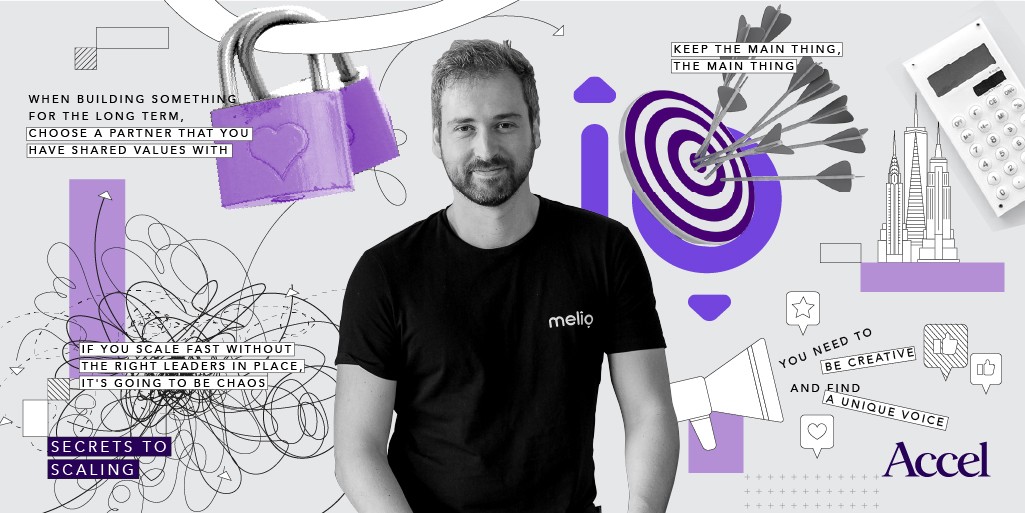
This post is part of Accel’s Secrets to Scaling series, where leaders from across our portfolio share their learnings and advice with the next generation of European and Israeli entrepreneurs building global winners.
The first time I met Matan, Melio's co-founder and CEO, he told me that his mission was simple: he wanted to “help small business stay in business” by making B2B payments fast, simple and flexible. Coming from PayPal, Matan saw no reason why small businesses couldn’t pay their bills as easily as consumers send money on Venmo - in just two clicks. He and his co-founders Ziv and Ilan have made this happen, with the company now processing multi-billion dollar payment volumes just over two years after launch.
Back in September, the company announced its $250 million Series D. As well as tripling the company’s valuation to $4 billion since January 2021, the round came as the company grew its monthly processing volumes by 5,000% in 18 months. I sat down with Matan to discuss his tips for hyperscaling with teams across two continents, the importance of focus, why the team set up a bookkeeper in New York, and much more…
Let’s start with your journey before starting Melio. You were head of PayPal consumer products, which is where you experienced first-hand the digitization of payments for consumers. And then you realised that there was a gap for B2B. So, tell us more about the inspiration for Melio…
At PayPal, I led the group responsible for peer-to-peer payments globally, and grew it to around $50 billion in payment volume, and more than a billion dollars in revenue. The growth was incredible; we rode the wave with the PayPal brand and the different products we’d built as consumers shifted from cash to mobile payments.
Digitization really accelerated with products like PayPal, Venmo, Square Cash and Revolut. It became a new standard for paying friends and family. But I was shocked to discover that this digitization shift hadn’t affected the way small businesses paid each other. It still largely relied on paper-based payment processes. The Federal Reserve reported that there were around $14 trillion of paper checks transferred each year by businesses in the US alone - this was another big push for us to start exploring the space more. There was clearly an opportunity to make B2B commerce more efficient, and more suitable for 2021.
We started exploring this opportunity, trying to understand exactly why B2B was so behind consumer payments. We reached various conclusions that led us to building Melio and the products we created to enable a B2B payment experience.
Tell me a bit more about the things you did to understand how small businesses work. You set up your own bookkeeping firm in New York, so I’m curious to hear your thinking around this and whether you think other founders should try and gain this first-hand understanding of the customer problem.
It was one of the most pivotal moments in our journey. When we validated why most small businesses in the US were still using paper-based methods to pay suppliers, we asked a simple question – “why?” Why do they continue to cling to paper checks and avoid using a digital accounts payable automation solution to enable B2B payments?
To answer this question, we interviewed different customers and prospects and quickly found that our understanding of the nuances of a B2B payment workflow wasn’t deep enough. We didn’t even know the right questions to ask small businesses so we became part of the small business workflow instead. We opened a small bookkeeping firm and managed end-to-end accounting and payables for 10 small businesses for around four months, purely for research purposes. The insights we gained from experiencing the B2B workflow firsthand helped us design a much more accurate solution.
One of the things that makes Melio unique is we bring a very consumer-oriented approach to a space that doesn’t live up to consumer product standards. When you really want to understand the consumer, you need to learn fast, see the reaction, learn from this, iterate and start building the next phase. Starting a bookkeeping service was the fastest way to engage with customers. Businesses would send us the invoices and tell us when and how to pay them. We’d then manually update the accounting software. Everything was manual - we didn’t write a single line of code!
But we learned so much, our engineers could develop a product that would imitate many of the things we did manually. This deep consumer approach will hopefully support a product that’s suitable for our target audience for the foreseeable future.
So is that something you’d recommend for any entrepreneur?
Yes. Finding a way to engage with customers - fast - is usually a good use of time. When building innovative experiences, it can be very hard to take a top-down approach where you create a strategy presentation and then build the product from this strategy. Sometimes, a bottom-up approach is the only way. Build the product, see the reaction, learn from it, and move on.
Let’s talk about your financing strategy. You raised four rounds within 18 months, waiting until your third round before coming out of stealth mode. What advice would you give entrepreneurs around fundraising strategy?
The round we did with Accel was in late February/early March 2020 – probably the worst time in the last 50 years to raise! Personally, I didn’t know what was going to happen with Melio as the pandemic was threatening to shut down small businesses and there was a huge amount of economic uncertainty nationwide. Accel took a bet on Melio in the most uncertain time we’ve experienced for a long while, which we’re very grateful for. In fact the term sheet was signed the day before the world went into lockdown!
The reason I mention this is that our fundraising strategy involves first and foremost choosing partners who are human beings that we’d like to join us on our journey. It may seem trivial, but this should be 90 percent of the consideration for any entrepreneur as building a business is a very long journey.
Picking people - humans - you want to work with longterm is the best strategy.
We didn’t know what was going to happen at the end of February, but COVID accelerated digitization in many industries. Every time we set a goal, it would quickly look too conservative – we realised we could do more. We could grow faster than we thought, hire more people, build more initiatives, and reach more users. We understood that we could set higher goals and be faster and more aggressive. But this would need more resources. So we took the opportunity to do a second funding round in August. We could now hire faster, spend more on growth, and maintain the costs we want to maintain. Overall, we grew more than 20 times in 2020 and tripled our volumes over a very short period of time. But we saw we could move faster again, set higher goals and a new budget, and raised again. It’s a question of setting goals and understanding whether you can actually use the additional resources. If the answer’s yes, you should probably raise again.
It seems to have worked well so far! Back to your personal story. Melio was your second company after The Gifts Project. Why did you decide to be an entrepreneur? What made you take the leap twice?
I love and feel lucky to be working in the fintech space. You can change lives through the combination of technology and finance. I realised through PayPal and my first startup the impact you can have on people’s lives when you make money better. Even when you make it slightly better it can be a game changer.
At PayPal, for example, I learned about the importance of financial inclusion and democratising financial services. I led groups that built products for the underbanked and unbanked populations in the US, providing access to financial products that were previously unavailable. Changing speed, changing costs, making money more efficient and transparent – I’m grateful that I know enough to help and have an impact on people and businesses.
When I decided to start another company, I wanted to create financial inclusion in an underserved market – providing tools that would set small businesses up for success and keep them in business. Large enterprises like Walmart have great tools to manage their finances, but a small wine shop owner doesn’t and including them in the financial system gives them some of the power of bigger companies.
I was lucky to have great partners – Ziv and Ilan – who wanted to build a company around the same time I left PayPal. I thought it would be fun to build something together, and it doesn’t get better than going from zero to one together when building a team, defining a new culture, or creating a product.
What advice would you give on choosing co-founders? And how did you find Ziv and Ilan?
On a short-term project, you should probably pick partners based on skills and capabilities. If you intend to build a huge company and work together for at least 10 years, I’d advise picking partners with whom you share values, just as in a marriage. Being married to someone with conflicting values is going to be difficult…Shared values is the number one priority. Obviously, co-founders have to be good at what they do too!
One of the strengths Ziv, Ilan and I have is our diversity. We’re very different – we have different voices and opinions. Diversity has a cost and a lot of value. You need to know how to debate well as not everyone agrees all the time, but with so many different perspectives, you usually reach a more ideal outcome.
And, of course, it’s important to pick people with relevant backgrounds for the success of your company.
Ziv has been a friend since I was 16. He may be the most resilient person I know, and cares for people and the community. I’ve always known of Ilan. He’s one of the best-known CTOs in Israel and is considered a guru in AI and machine learning. I spent a ton of time with him in the year before we started working together. Again, as in a marriage, there’s often chemistry. I knew very quickly that he was someone I’d want to work with. And I was right - we get along better each day.
Shifting gears…let’s talk about the US. Like a lot of Israeli companies, your product and R&D teams are in Israel while you target the US market. How did you make this happen so quickly?
I had some experience of this from PayPal. The app was built in Tel Aviv and launched in 200 countries / regions where the US was the main market. We had to compensate for not operating in the main market where our customers were.
With Melio, our customer-facing teams and business functions are all based in the US as it’s our target market. But we started an R&D centre in Tel Aviv because we have great access to engineering talent. And we’ve built a reputation here – personally and commercially – that helps us attract this talent. We’ve been able to attract people from Facebook, Google, Amazon, and other startups. Access to engineering talent in particular is one of the biggest challenges for any technology company globally and should always be a key consideration.
Being distant from the market is a disadvantage, though. You’re not using your own product in the country you operate in. So you need to ensure you set processes to keep your people engaged with customers, whether it’s weekly customer interviews, or having customer support and engineers working side-by-side every two to three weeks. When we have an all-hands, the sales team plays recordings of customers so everyone can hear their stories and voices. Having the processes in place to make sure the customer is central to the company’s content is a huge compensation for the company.
Regarding people and teams, how did you scale the company so fast across two continents, and ensure you hired the people with the right values and cultural fit? In the first phase, you can see everyone. In the second, you rely on people you’ve hired to hire more people. How did you think about this, and what’s your advice for other founders?
You and other investors gave me some great advice: “It’s OK to scale fast, but if you don’t have the right leaders in place, it’ll be chaos.”
We grew from 35 people in January 2020, to more than 400 by the end of August 2021 – an incredible pace. If I hadn’t had strong leaders for the US, sales, customer support, and R&D, it would have been chaos. So when you’re planning to build a team from zero to 50, you need to pick the right leader.
For a long time, I was proud to have a culture that didn’t require us to set a policy. Anytime we could use culture rather than set a policy, I felt that was adding a million points to the probability of us succeeding as a company. Culture isn’t the annual fun-day, it’s when people come to work or go home, how they talk to each other in meetings, whether they’re inclusive and genuinely listening to other opinions. Getting to and then maintaining this culture depends on endless feedback between me and the people I manage, and vice versa. This feedback culture then extends to all teams across Melio.
If you want to change culture and instil values, do it while the company’s young. The personalities of the first people to join a company dictate the company’s personality.
There’s something contagious about the way a strong core group operates. But changing that five years from now would be much harder than changing it now.
Any other learnings you’d like to share on hypergrowth? What tips could you offer?
Keep the main thing the main thing. Everyone talks about all the right things, but there are so many right things you need a strategy to help you decide what to do. We’re pulled in so many directions, if we didn’t have a clear focus we’d try to do too much or diverge from our core strength. The strategy should reflect that strength, along with the company’s vision and mission.
Focus is everything. If the priority is clear and right, you can afford to have more options around how you use the resources you have.
You’re operating in a market where there are lots of opportunities, so it’s even more important. Let’s go to some more personal questions. Looking back to when you closed your Series A, what do you wish you’d known then that you know now?
Entrepreneurship means you need to be optimistic – good things will happen with hard work and a strategy. But there are a lot of unknowns. When people encounter unknowns, they tend to be more conservative, so there are certainly some areas where I should have been more optimistic and aggressive. Hindsight is useful but believing in your future self is important in entrepreneurship.
Any life hacks or habits you’ve developed to cope with the pressures of being an entrepreneur?
Exercise – I think I’m 50 percent smarter when I work out. It helps keep me focused and sharp and make better decisions. Entrepreneurship is tough. There are many days when we work 15 or 16 hours. It’s important to make sure you fit in your exercise. It’s a critical activity for my day-to-day work. We also do different sporting activities in the office. Even when we were bootstrapping, we made sure we had a yoga instructor come in twice a week for the team as everyone found it really valuable.
In closing, what’s been the hardest thing about building Melio that you didn’t anticipate? And what’s been easier?
The hardest thing is finding great people – at all levels, from hiring a great engineer to hiring a leader for a 100+ person sales team. It’s a combination of so many things, like personality and skills. And the market is becoming more competitive.
But like anything else in entrepreneurship, creativity wins. When you’re creative, and you find a unique voice, you find new solutions.
I’m not sure what’s easier. The growth has exceeded our expectations, but that was surprising and super hard rather than easy! I don’t think there’s much about this journey that’s easy. If you want easy, there are other jobs out there…
*****************