Showing posts with label Eastern Europe. Show all posts

Wednesday, April 21, 2021

From humble beginnings to market leadership: UiPath rings the NYSE bell!


UiPath rings the bell at the NYSE

Sometimes the most surprising outcomes originate from unexpected beginnings and we are honored to be part of the UiPath story.  

Founded in Bucharest, and now headquartered now in New York City, UiPath rang the bell this morning at the NYSE, becoming the largest public cloud company born in Europe. Congratulations to Daniel Dines and the UiPath team for this incredible accomplishment!


UiPath was founded in Bucharest in 2005, selling computer vision technology to OEMs. It was a difficult time of exploration and iteration, as many founders experience, and it took 10 long years to build the company from $0 to $1mm in revenue, a difficult phase.  During those early days, Daniel and the team learned the importance of humility and it became the cornerstone of the company’s culture:


“Humility gives you the opportunity to course-correct fast. I think this is the most important business lesson that I ever had in my life”

Daniel Dines


The key breakthrough came in 2015 when Daniel and his co-founder Marius saw how computer vision could be used to emulate human behavior and automate repetitive tasks for every range of business processes. With this vision in mind and a small 10 person team, UiPath shifted course, launched its first robotic process automation (RPA) and went on to become one of the fastest-growing cloud companies of its generation.  After going $0 to $1mm in their first 10 years, UiPath has now hockey-sticked to over $600mm in revenue in 2020, and the automation market is still in early innings. 


When we got to know Daniel in late 2016, we saw someone who was thinking differently. Born behind the iron curtain and despite the humble beginnings of UiPath, Daniel had global ambitions from the offset. In early 2017,  while the company only had single-digit revenue, it was already operating in North America, Europe, India and Japan. 


Leading Enterprise Automation Platform


In 2017, RPA was nascent and still very much under the radar, but we had a strong thesis around enterprise automation and AI. As digital transformation started to be on the agenda of large enterprises, Daniel’s vision of “one robot for every person” really resonated. Several signs also pointed to something special happening around RPA. For example, UiPath was able to sign a high six-figure deal with a Fortune 50 company in less than four months. Typically, it would take an early-stage start-up 12+ months to land a deal like this. 


Joint Symposium on Automation in June 2018

As UiPath evolved from RPA to a full enterprise automation platform, the flywheel accelerated and customers kept buying more.


“…the [UiPath] platform can be used successfully across our organization –from individuals to departments –to deliver value swiftly, easily and inexpensively.”

Business Enablement Executive, BMO-Harris Banks


A meteoric rise to market leadership


While UiPath is known as an “overnight success” by many, the reality is that after growing from $0mm to $1mm in its first 10 years, UiPath was able to grow $1mm to $600mm in the following 5 years. UiPath quickly emerged as the market leader in the Forrester Wave quadrant as the technology evolved from automating mostly finance and accounting processes to address processes across all industries and functions.


We feel privileged to have shared this unique journey with Daniel and the team from the early days when they chose us to lead their Series A. As the company rapidly grew, so did the need for capital and we offered to lead the series B from our global growth fund. It has been a pleasure to support the company in its fast growth over these past 4 years, and we are deeply grateful for the opportunity. 


At Accel, we understand that innovation can come from anywhere and have had the pleasure of working with founders around the globe such as Stewart Butterfield (Slack from Vancouver), Daniel Ek (Spotify from Stockholm), Ryan Smith (Qualtrics from Provo), Scott Farquhar and Mike Cannon-Brookes (Atlassian from Sydney), and many others. Daniel Dines (UiPath from Bucharest) is yet another great example of this growing trend. The company became the first Cloud decacorn born in Europe last year and today’s public market entry is another notable milestone in their journey.


Congrats!

Today, we are very excited to see UiPath following the path of other cloud leaders from around the world. Big congrats again to Daniel and his team for this amazing accomplishment. It has been a privilege for us to be part of this journey and we can’t wait to keep supporting this next phase of the company.


- The Global Partners of Accel


Tuesday, July 14, 2020

UI Path: the first European Decacorn is born


From Bucharest to the World


As we boarded our flight back to London in early February 2017, leaving behind the Bucharest winter, our team was incredibly excited by the two days we spent with Daniel and his team. Yet, it was hard to imagine that a short three and half years later UiPath would become the first European Cloud Decacorn.


What an incredible journey for this company born in Romania. This new financing of $225m valuing the company at a post-money of $10.2B is an incredible milestone, rewarding one of the fastest-growing cloud software companies of this generation.


This success is the testament of the hard work and relentless ambition of the founder, Daniel Dines and his co-founder Marius Tirca. Together, with a passionate and dedicated team, they pushed the limits of global growth, democratized the access to automation technology, and transformed the way enterprises of any size could harness the power of automation.

______________________________________________________________

"COVID-19 has heightened the critical need for automation...

we are committed to working harder to help our customers evolve,

transform, and succeed fast in the new normal"

Daniel Dines, founder UiPath

______________________________________________________________


We feel very fortunate and grateful to have been part of this journey from the early days, leading the series A in 2017 and the series B in 2018, and to have supported the company in every financing round since including the recently announced Series E this week.


While much of startup entrepreneurship activity historically centered in Silicon Valley, at Accel, we believed many years ago that Silicon Valley was not only a place but a state of mind. Technology entrepreneurship is exploding around the world and we seek to connect with the next generation of entrepreneurs everywhere, leveraging our offices in London and Bangalore. UiPath and Daniel Dines are the perfect example of a company founded locally but scaled globally.


It is a privilege to be working with this visionary team, and it has not always been an easy ride. Hypergrowth creates its own challenges and it is hard to build solid processes when you are running at 100 miles per hour. The company had to streamline its processes at the end of last year. Then came COVID, the black swan. And again, UI Path showed its resilience and adapted very quickly to this new environment, making some disciplined choices but emerging bigger and stronger, with more than $400m ARR run rate. 


Cloud Decacorn: big milestone for Europe


We all remember 10 years ago when the number one question was “Can Europe generate a $1B company”. Old times! With this financing, Europe is marking its first Cloud decacorn, following in the steps of Supercell and Spotify on the consumer side. This is a significant milestone for an ecosystem which has experienced exponential growth in the past decade.


The combination of strong tech Universities, the growing interest from large enterprises to embark on  their digital transformation and the rising level of ambition of the new generation of entrepreneurs creates a fertile ground for innovation.


The ecosystem, which was mostly centred around London and Tel Aviv 20 years ago, has become increasingly more fragmented with the emergence of 10-12 hubs across the region. Our last 25 software investments were based in more than 13 cities, including Altrincham outside Manchester and Aarhus in Denmark. It shows that innovation can come from anywhere in the continent and  “Silicon Valley” is a state of mind.


We came to Europe 20 years ago, and even though COVID 19 limited our ability to celebrate this milestone, witnessing the first European decacorn is above any celebration we could have hoped for. 


Global Cloud Factory 


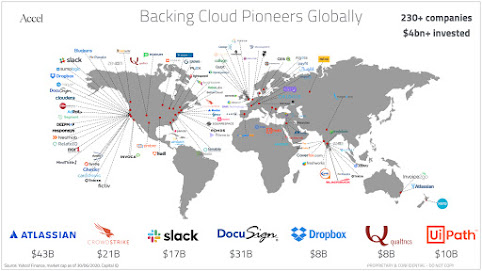
We are very happy to see UiPath, as a European company, join the Accel Cloud decacorn family with other leaders from around the world such as: Atlassian, Crowdstrike, Docusign, Dropbox and Slack. 


At Accel, we love SaaS and Cloud and have invested close to $4B in 230+ companies globally. We believe that category-defining companies are founded all over the world, and while the first Trillion dollars of cloud market cap has come mostly from US-based companies, we expect the next Trillion dollars to come from many hubs across the globe. These smaller hubs can shape companies with growth-oriented DNA because their founders are required to think beyond their local (often smaller) market to plan for a global business from day one. While Silicon Valley will remain an epicenter of technology innovation, we expect to see an acceleration of cloud entrepreneurship globally, following in the steps of UiPath in Europe, Freshworks in India, Xero in New Zealand and  Atlassian in Australia. 


Big congrats and thank you to Daniel and his team for this great success and for what it means for the European and global tech ecosystem, and we look forward to continuing our small role in supporting their journey.


__________________________________

“I want a robot for every person”

Daniel Dines, founder UiPath

__________________________________


***********************


Wednesday, October 24, 2012

Eastern European Champions & the 4 V’s of Big Data

Eastern European Champions
I had the opportunity to do a keynote at the IDCEE conference in Kiev last week. It was my first time in the city and I must say that I was immediately taken by the energy of the city and of the entrepreneurs that I met at the conference.

It took me some time to figure out a title and I eventually settled for “Building European Champions” as the region has proven its ability to generate very successful venture outcomes and will continue to be the birthplace of many successful technology companies. I would categorize these champions in two camps: the “Local Champions” and the “Global Champions”. The first category includes companies that have a dominant position in their national market and are often internet or ecommerce companies. This category would include among others Yandex, Mail.ru, KupiVIP and Avito in Russia as well as Allegro in Poland. The second category is composed of companies that have developed a unique IP locally and marketed it worldwide - typically in the gaming, software, security or mobile sectors. Skype is probably the most famous of them, but there are a lot of other examples including Game Insights, Kaspersky and Parallels in Russia, LogMeIn and Prezi in Hungary and Avast and AVG in the Czech Republic.

Why Eastern Europe?
Looking forward, Eastern Europe has several assets and macro trends that will contribute to foster more innovation and create successful technology companies:
  • 400m+ people in the region
  • GDP of $3T+ with most countries growing 2-5%+
  • “Runet” (Russia Internet) is the largest market in Europe with 53m internet users and given its under-penetration (37%) it is still growing at double digits, increasing the gap with Germany which is currently number two and growing at 2% per annum. Out of these 53m internet users, 15m are shopping online, creating a fast growing $11B ecommerce market in Russia alone (expected to reach $19B by 2015)
  • The mobile penetration is among the highest in the world with 1.7 mobile phone per person for the Top 4 EE countries (vs. 1.2 in GE, 1.3 in Brazil and 0.8 in India and China)
  • The region has an exceptional talent pool: Eastern Europe was the first country to send a man into space in 1961 and has a very strong network of universities. It is not by chance than a Moscow team won the 2012 FB Hackathon with Boostmate, a tool to analyze social interactions and rank your closest friends.

In addition, the availability of cloud and open source technologies has further reduced the cost to get a technology business started as now anyone can get computing and storage capacity in the cloud or build a LAMP stack for a few hundred dollars. This low entry barrier should accelerate the pace of innovation.


A few facts on Big Data
I took advantage of this keynote to highlight a few areas where we see a lot of opportunities globally and in particular for Eastern European start-ups: Big Data, Cloud Computing and Mobile. I will elaborate a bit on the first one – Big Data.

Big Data is a key area of focus for our firm to the point that we even created a $100m “Big Data Fund” recently. Going through several reports, I found a few mind-blowing stats on the growth of structured and mostly unstructured data. Here are a few examples:
  • 247B emails are sent every day (and the scary bit is that 80% is spam!) 
  • It costs $600 to buy a disk drive that can store all of the world’s music
  • 30B pieces of content are shared on Facebook every month
  • Projected growth in global data generated annually is 40%. By 2020, the production of data will be 44 times what we produced in 2009
  • 15 out of 17 sectors in the United States have more data stored per company than the US Library of Congress
Big Data is indeed…big! And getting bigger and bigger.

The 4 V’s of Big Data
Big Data is different from "large amount" of data. We have tried to define Big Data around a framework of four V’s that explain the essence of the concept: Volume, Variety, Velocity and Value:
  • Volume: the first V is easy to grasp as it is about quantity. The proliferation of mobile phones, social media, machine data, web logs has led to large amounts of data being generated, stored and processed and this volume is increasing exponentially with the growth of new computing platforms and the shift of activities from offline to online
  • Variety: this is where big data starts to differ from “a lot of data”. Big Data is not only about volume but also about the type of data. Large volume of structured data can stored in relational databases and accessed quickly by queries. Big Data contains structured data but mostly unstructured data (which is the key driver of growth as shown in the graph above). And this unstructured data contains valuable information that can now be extracted if the right infrastructure is in place (e.g., sentiment, preference, mood, purchasing intent)
  • Velocity: Time is of the essence with Big Data. Business users need faster and faster response rate to derive the most value from information. Sometimes it needs to be in real time. The more data to analyze and the more challenging this becomes as all the pieces of the infrastructure needs to be perfectly tuned
  • Value: This last V’s characterize the underlying purpose of storing Big Data – to derive business value. This means that on top of the technical aspect of storing and managing Big Data, there is a need for a strong BI and visualization engine to drive insights beyond data scientists

Looking at these four V’s helps define the underlying opportunities around Big Data: there is a need for larger and cheaper storage, fast access, data management tools, platforms (like Hadoop), BI and visualisation engines and new business applications that can help businesses capture, organize and derive the most value from Big Data.

I will finish this post with one example that came out of a discussion with the IT executive of a large US bank. One of the big data team collected and analyzed all the data of accidents on Route 101 linking San Francisco to San Jose. They found that a large part of the accidents were due to random objects falling from trucks on the road. Digging deeper, they found that a large part of these objects were real estate signs and they were able to correlate spikes in the number of accidents on route 101 with a shift in the real estate market in the bay area in quasi real time. Impressive! 

And this is just the beginning.