Showing posts with label AI. Show all posts

Thursday, October 17, 2024

Euroscape 2024: AI Eating Software

 Euroscape 2024: AI Eating Software


The Accel 2024 Euroscape was unveiled earlier today at SaaStock in Dublin and you can view the full presentation here.


*********************


AI - the main driver of value creation in the tech world


AI is rewriting software - literally and figuratively. The NASDAQ keeps climbing higher, up 38% in the last 12 months and beating new all time highs. Out of the $8.4T of value created in the past year, $5.3T is coming from the six tech titans that are investing tens of billions into AI: Apple, Microsoft, Google, Meta, Amazon and Nvidia. As AI is starting to unlock an unprecedented wave of productivity improvements across the enterprise, the development of this new tectonic shift seems unstoppable. 
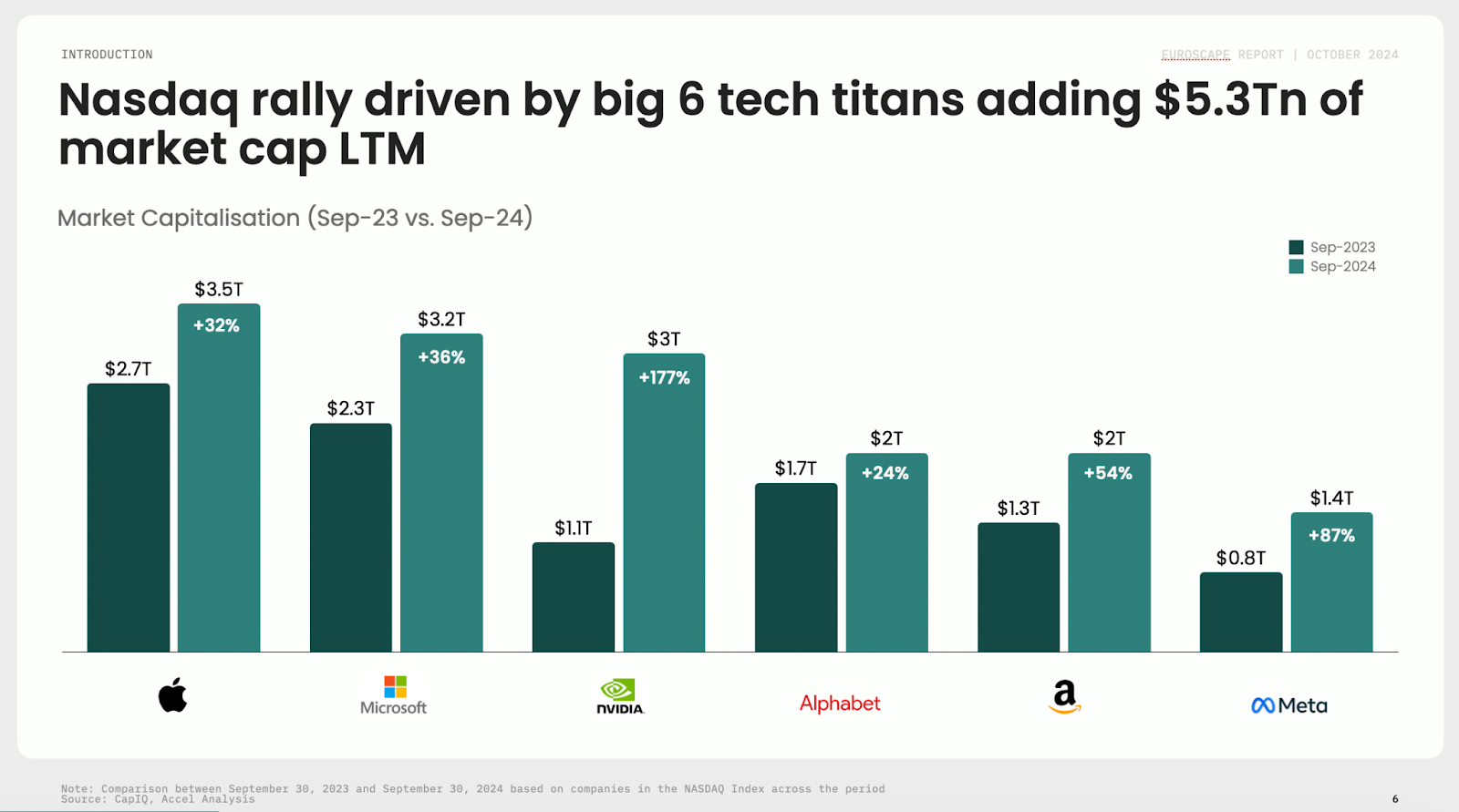


However, outside of the world of AI, the perspective isn’t as bright, with shadows of geopolitical uncertainties and the risk of recession looming.This environment combined with the digestion of 2020/21 high software spend and the shift of enterprise IT budgets to AI has been hard on both public and private cloud companies, putting huge pressure on growth. The Euroscape Index of public cloud companies has progressed at half the pace of the Nasdaq and the average growth rate shows a decline from 47% at their peak in Q2 2021 to 15% in Q3 2024. In 2021, 23 companies in the index were growing more than 40% per year compared to none today. The era of high software growth is fading away and leaves companies no other choice but to focus on profitability.


In this context, the cloud IPO market shows little signs of reopening. However, M&A activity remains solid, with 2024 already above 2023 at $58.7B. The M&A market remains driven by very large deals, with  Synopsys’ acquisition of Ansys for $35B being the largest this year so far. The big tech titans are still missing in action, constrained by intense regulatory pressure and their focus on AI. The take private activity also remains healthy with 2024 on track to reach $40B, which is in line with 2023.


AI investments pushing venture funding back up


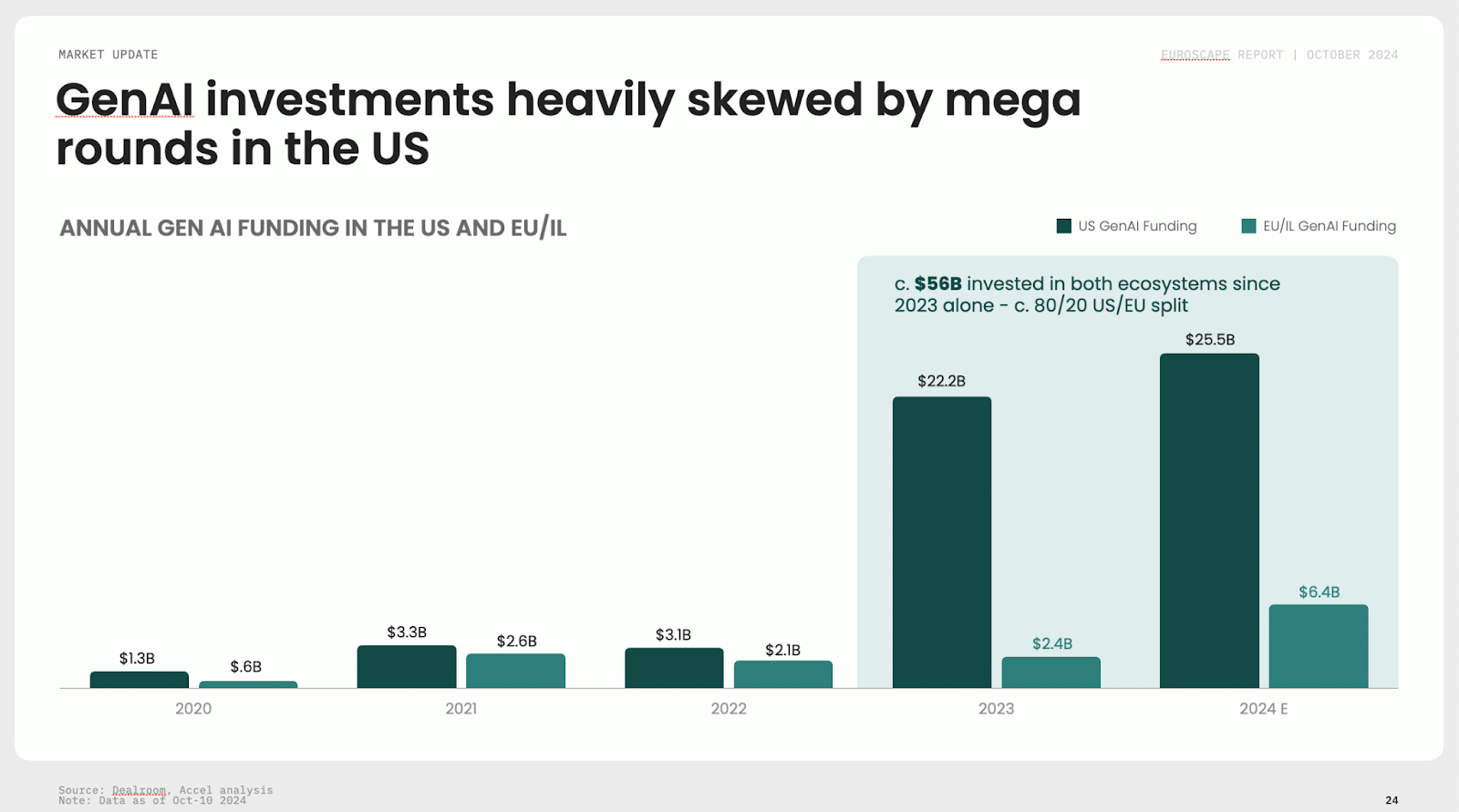
After three years of consecutive decline, funding of private AI and cloud companies across the US and Europe is climbing again at $79B, up 27% vs. 2023 and 65% vs. 2020. With AI making up $32B (40.3%) of this number and driving the majority of growth, non-AI funding is now tracking 2020’s levels at $47.3B.


When we zoom in on venture AI financing, three facts are striking:


  1. US is leading the AI race: out of the $56B invested in 2023-24, roughly 80% has gone to US companies vs. 20% for Europe and Israel

  2. The investments are heavily concentrated with ⅔ of the funding going to the top 6 companies in each region

  3. ⅔ of the funding has been invested in companies building foundation models


These numbers reflect the expectation of the venture community that a limited set of 12 or so companies will generate tens of billions of dollars of value in the next 5-10 years to justify these levels of investments. With OpenAI recently valued at $150B+ on the back of record breaking revenue growth, we don’t expect the flow of investments to slow down in the short term.


As billions of dollars are being put to work, the pace of development of new models is increasing, evolving from text to multi-modal, the performance of the model is increasing across all benchmarks and the cost of inference is pushed down drastically - eg. the cost of inference for 1,000 tokens on GPT4 has gone down 90% from March 2023 to May 2024. Huge progress is also coming on the text to video creation side with impressive previews from Google and Meta and Black Forest Labs (the team behind Stable Diffusion) expected to release a new video model in the coming quarters.


Game of AI thrones 


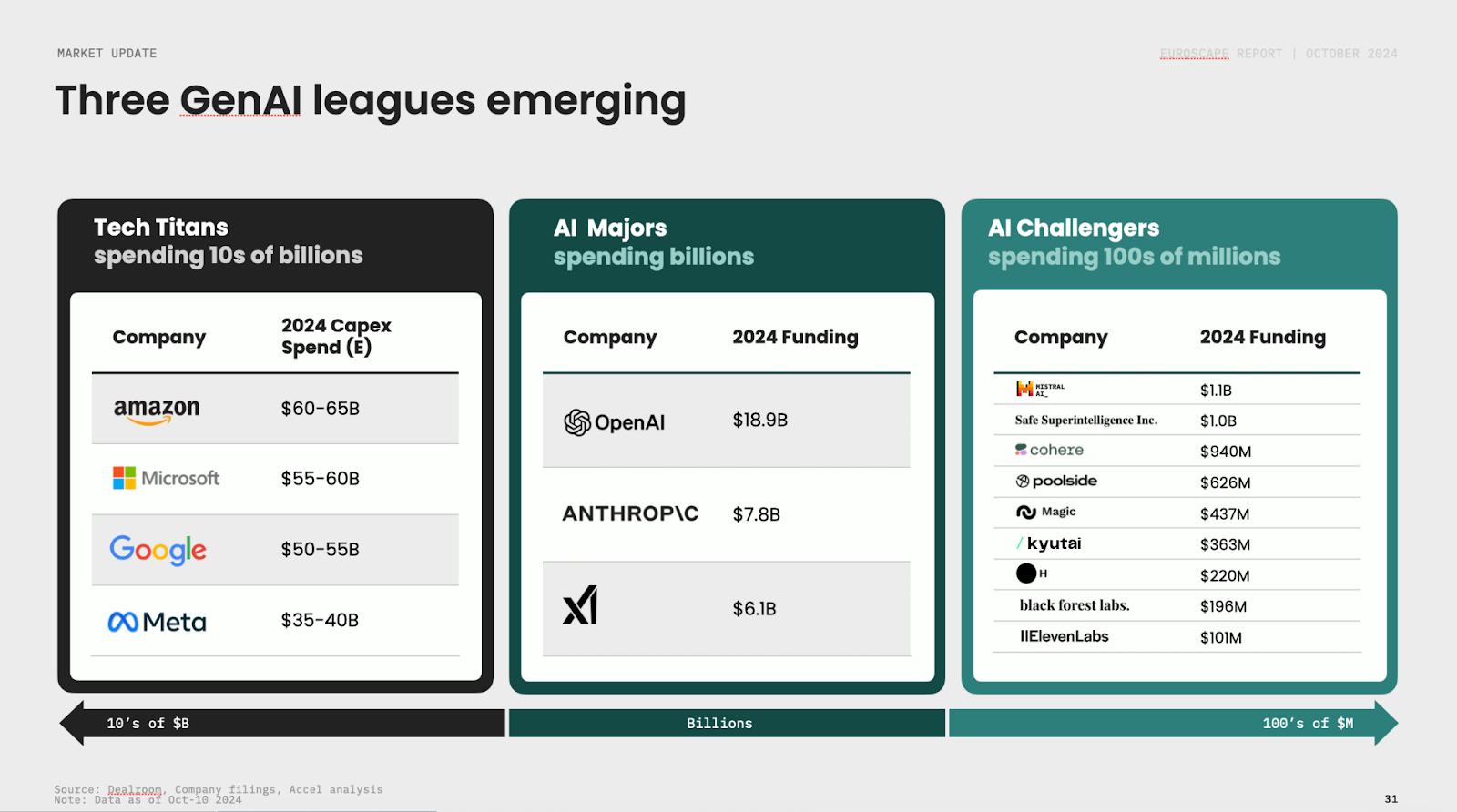
Will AI foundation models be a “winner takes all” market? Probably not. While Microsoft has a strong head start with its relationship with OpenAI, we are just in the very early innings of the race and it is too early to call it. If we look at the world today, there are three AI leagues:

  1. The Titans: Amazon, Microsoft, Google and Meta, investing each $30-60B in AI per year, including capex

  2. The Majors: OpenAI, Anthropic and X, each spending billions of dollars per year

  3. The Challengers: a small number of scale ups (eg Cohere, H, Mistral,, Black Forest Labs etc…) each spending 10’s to 100’s of millions per year


It will be interesting to see in the coming months if investment capacity is the only driver of success or if more focused models and workflows can take the lion’s share of specific markets. In many applications and in particular in everything touching enterprise workflow automation, cheap inference costs and very low latency are key requirements, leading us to think that more focused models will play a significant role in the future. 


The rise of Enterprise Agentic workflows


Text focused models have started to impact the productivity of enterprises primarily on the software development side, improving productivity of developers by 20%+, on the customer support side, dramatically deflecting the number of contacts managed by humans (numbers we are hearing are in the 20-40% range and increasing) and on the media creation side. Next to these use cases already in production, most large enterprises have been experimenting with internal applications and expect to deploy them next year.


We expect the next generation of models to include agents specifically trained to execute business tasks and workflow. These models will generate a new wave of automation for enterprises as AI will handle the execution of more complex tasks and tasks with a large number of possible outcomes that current automation tools are struggling to address. Initial announcements have been made by Microsoft and we expect new releases in this field next year and enterprises to start experimenting with them. One challenger to watch is H, the foundational companies focusing on agentic workflow who received investments from UiPath and is expected to release their first product in the coming months.


The top 100 2024 Accel Euroscape winners


As AI dominates the cloud world, it is not surprising to see a big shift in the list of winners this year. We’ve also adjusted the categories to reflect the new landscape of AI driven business models. You can see the full list and more in the report here


************************************************


At Accel, we can’t be more excited by the trends we are seeing around AI and the new generation of AI-native applications that will be created in the coming years. We believe this secular trend will continue for the foreseeable future and redefine the way application and software will be written. We have been very active in the category with investments in Scale, Synthesia, H, Decagon, Assembly, Ema, Gamma, Vercel among others and expect a large part of our new investments to fall in this category.


We’ve deployed more than $10B across 400+ AI & cloud companies in the past four decades and have been fortunate to partner with many exceptional cloud & AI founders globally. While there is still an imbalance today between the US and Europe on AI, we expect eventually that this difference will flatten and that AI winners will come from anywhere, like we have seen for cloud companies: from Atlassian in Australia to UiPath in Romania, Celonis in Germany, Snyk in Israel, and Docusign and Crowdstrike in the US. We can’t wait to see what the next decade will bring.


************************************

Thursday, June 24, 2021

“Growth and scaling are the hardest things to get right” - Chainalysis’ Michael Gronager


Earlier this year, Chainalysis announced its $100 million funding round, valuing the company at more than $2 billion and marking the fact that cryptocurrency is now mainstream. Since its Series C in November 2020, Chainalysis has increased ARR by more than 100% year-over-year, doubled its client base and now supports more than 100 digital assets across 10 native blockchains (around 90% of cryptocurrency economic activity). It’s been quite a journey getting here and there’s still a way to go as cryptocurrencies integrate with our global financial system.

I sat down (virtually) with Chainalysis co-founder and CEO Michael Gronager to discuss his learnings from almost seven years at the helm of a high-growth company. He shared his tips for building a global business, hiring, what he’d do differently and more…


The Chainalysis journey

PB: Let’s go back to the start. What was your career prior to founding first Kraken and then Chainalysis? What attracted you to entrepreneurship?

Before Kraken, I was planning and running public research infrastructure projects across Europe. Essentially, I was just doing politics and talking to research councils to get funding. I got to a point where I thought the purpose of the education and research systems we were creating was for people to build companies and that those who could do, should. After a conversation with a colleague, I decided to build something myself. I started coding iPhone apps and got one off the ground for a US company. This gave me some financial freedom, so I quit my job and was soon bitten by the crypto bug. 

I started reading about Bitcoin when the price went crazy high - growing from $1 to $32! - and then crashed to $15 in 2011. I saw Bitcoin as a new paradigm in computing, creating digital scarcity where something digital couldn't be copied and you could only transfer its value or symbolic value. I looked for places to meet other people who thought Bitcoin was cool and found the first ever conference in New York. I met [Kraken co-founder] Jesse Powell here.

How did Kraken come about?

I’d been experimenting with distributed payments online and couldn't figure out whether to create a business around this or not when Jesse contacted me about a crypto exchange he was building. It sounded fun, so I went to San Francisco to join the team and Kraken launched in summer 2013. It was perfect timing - Bitcoin that year went from $10 to $1,000.

How did you get from there to Chainalysis?

Mt Gox, the biggest crypto exchange, went bankrupt in early 2014, losing about half a billion dollars following a hack. This caused a big downward spiral of everything crypto. It was associated with criminal activity, hacks, online drug sales, terrorism and more. No one wanted to talk about crypto, so running an exchange was tough. Talking to banks and regulators in Asia, Europe and the US, I kept hearing the same issues: they couldn't monitor transactions, no one understood the return of funds, and - most concerning - crime couldn’t be investigated. I thought about this, read the original Satoshi article and others on how it was possible to trace, execute and build a data layer crypto. I then decided to try and solve the obvious problem of understanding the flow of funds in the most transparent financial ecosystem ever created.

I left Kraken and created the Chainalysis prototype on my flight back to Europe. I had a lot of Bitcoin code and software so the proof of concept was basically 50 lines of code. I could build out clusters of transactions, enabling you to see different services and create the early map of crypto. It was then a case of finalising it, bringing Jonathan and Jan on board, selling it, and here we are!

Learnings for the next generation of entrepreneurs

Many European founders wonder where to start their company - move to the US or stay in Europe. Why did you decide on New York and then build Chainalysis’ organisation between there and Copenhagen? 

In the best of all worlds, we’d have probably moved to San Francisco. There’s great talent, a lot of investment and programmes like Y Combinator. You can get capital and be up and running in the blink of an eye. But, when setting up, we wanted to maintain a European connection for developer resourcing and build some of the team out there. I also had family in Europe. Having a nine hour time difference between Copenhagen and San Francisco didn’t make sense. Proximity to Washington DC was going to be key for US government customers and the heart of finance was in New York so it made sense to set up shop there. There are two key reasons we didn’t just stay in Europe: there’s a sales momentum and energy in the US that we wanted to tap into to win the global market, and building trust with US government agencies would have been harder if we were seen as a European company. We had to be US-based.

How did you initially think about going global from a sales perspective? With the crypto ecosystem, you’ve got a big buyer in US government agencies, Chainalysis’ European roots, the UK’s GCHQ, and a lot of crypto activity in Asia. It's challenging for a young company to deal with three continents and time zones for sales. How did you do it?

We ran a lot of our sales calls over Skype, sitting in various places doing early or late calls every day with exchanges or law enforcement agencies worldwide. It worked pretty well. We were quite successful selling the product to both government agencies and exchanges purely online. But growing these accounts later typically required travel. Once the customer had bought the product, we had to get on a plane to drive adoption and upsells. I’d be jumping all over the world for these meetings. It was a lot of travel. One of the things I’ve enjoyed with the pandemic is not always sitting on a plane!

Now you’ve had five or six years of global expansion, is there anything you’d do differently?

I think that setting up and building a team in one office with a strong focus on product and design and so on would have been a slight advantage over hiring people via the internet all over the world, so I’d probably do that now.

I’d maybe even have moved to the West Coast at the beginning. When you’re trying to attract commercial talent at higher levels, it still has an advantage. It’s probably 10 times the talent pool of the East Coast and another 10 times that of Europe. This isn’t the case when hiring engineers - the quality across Europe is better than most of the US, in my opinion. But for leaders in sales and marketing, there’s a lot of high growth company history on the West Coast to draw talent from. 

Let’s dig into this. Hiring execs is one of the most important things for high growth companies. How do you view the composition of your team and proportion of people who’ve done the job before versus those growing into roles?

I think it was Eric Vishria who said he’d split it so 75% of the team have done the job before and 25% are growing into roles. I think that's right, but the key question is: “what does it mean to have done the job before?”. There are probably only a couple of COOs who’ve successfully built a company from $5m to $5bn revenue over 10 years and they likely don’t need or want to work anymore. I’m looking for people who’ve experienced high growth. There are tons of companies that have built hundreds of millions of revenue over 20 to 30 years, companies growing at 20-30% year-over-year. These companies grow at a pace most people can handle. They don't experience the same issues as high growth companies and it’s the high growth experience I’m interested in.

It’s important to me that they've been part of the ride overall and seen a company fall apart constantly and need fixing. You're basically driving a car too fast. But high speed racing cars are meant to fall apart. They regularly need new engines and tires and that’s what happens to a company when it grows at 80-100% year-over-year: you need to have the mindset that Band-Aids are your best friend and the company needs duct tape all over. Getting the company into this mode of constantly fixing and changing every component is the hard part. I'm looking for two thirds to three quarters of the team to have experienced that.

I like the racing car analogy - it brings me nicely to the role of company culture and values in keeping things together. What values have you created for Chainalysis?

Early on, we got a lot of cultural input from Techstars. We inherited their value “Give first”, a way of interacting with others so everyone wins. The other value to highlight is “radical gradualism”, which means aiming big but understanding there are many subtle, smaller steps that need to be applied along the way. This is very relevant to the early crypto days where everyone would say, “we’re taking over the world this year, governments are gone, everything’s done and this is happening now”. But this isn’t how change happens. Even the internet took 20 years and that’s fast for global change. Understanding all the steps and winning over stakeholders in the right order is the important part. Radical gradualism can be applied to problem-solving all over the company. Have the mindset of getting to the moon, but recognise there are many steps to building the rocket and getting it into orbit and beyond.

Chainalysis has developed a very mission-driven attitude from working closely with law enforcement. Many things we’re doing are seriously important - people's lives are at stake - and they’ve become a core part of our company culture. More important than value creation, it’s the bigger goal of creating a better world.

This is an important point. Chainalysis has been involved in some high profile cases. What accomplishments are you most proud of?

One that stands out for me is our involvement in the shutdown of the largest ever child pornography site in October 2019. There were more than 300 arrests across 38 countries and at least 23 minors were identified and rescued from abusers as a result of this investigation. I felt that if this was the only thing I ever accomplished it would be good enough for me.

Last year also saw the largest seizure of cryptocurrency - more than $1 billion - in the Department of Justice’s history. We’ve got a lot of “biggest, fastest, most important” cases on our resume and they're all cases to be proud of.

Looking back to when you started Chainalysis, what do you wish you’d known then that you can share with the next generation of founders?

I wish I’d properly understood the nature of fast growth and getting it right from the beginning. Growth and scaling are the hardest things to get right. We all get excited when we see growth for the first time. But it’s important to understand that getting to the point where you have a product, some customers and a million or two in revenue is just the start. Many companies get there, but never figure out how to scale beyond this. Maybe there’s no product-market fit, for example. Or maybe they do scale, but headaches start because they do it too quickly. It’s tempting to grow fast, but it’s hard to reach a stable growth curve. Growing by more than 100% is tough - it’s a muscle that needs to be built over time.

Building a business is always tough especially when growing as fast as Chainalysis. Are there any tips or life hacks you’d share with other entrepreneurs?

Developing routines helps in various ways. I try to exercise every morning, getting up and running so I know it’s done ahead of a day packed with meetings. I try to find joy in the small things. Ensure you have some of that during the day - whether it’s your morning run or cooking, for example. I like to cook as you can mentally get into another zone.

Try to also take one day off a week. I can’t take two days off, but I try to have Saturday as a reset day. Get your mind in another place and don’t think about work for several hours. It’s important for mental health as the other days will be 100% occupied with work.

What’s been the hardest thing about building Chainalysis that you didn’t anticipate?

Probably the fact you become another person on this journey. And you want to, but there's stuff you sacrifice. Not spending much time with my kids is tough. But when you're building something and you get into this mindset, it’s like you’ve swallowed a pill. Change just happens. Some of the life changes are tough, but you get to experience things that very few people do. I'm deeply grateful for that and hope I can share some of this with my kids at some point - this is a journey I can bring them on in various ways too.

Tuesday, July 14, 2020

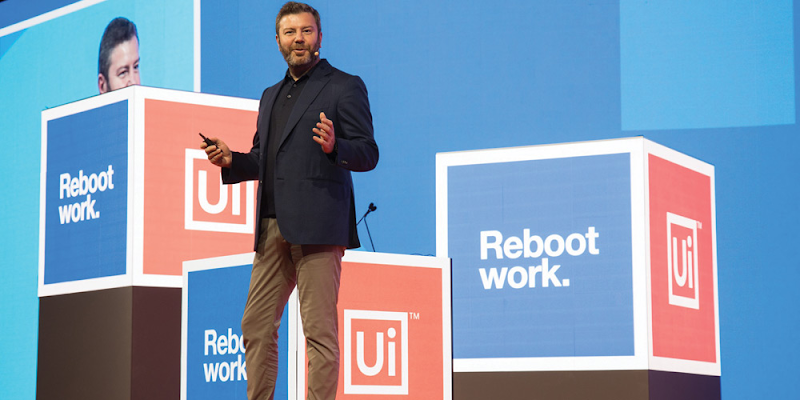
UI Path: the first European Decacorn is born


From Bucharest to the World


As we boarded our flight back to London in early February 2017, leaving behind the Bucharest winter, our team was incredibly excited by the two days we spent with Daniel and his team. Yet, it was hard to imagine that a short three and half years later UiPath would become the first European Cloud Decacorn.


What an incredible journey for this company born in Romania. This new financing of $225m valuing the company at a post-money of $10.2B is an incredible milestone, rewarding one of the fastest-growing cloud software companies of this generation.


This success is the testament of the hard work and relentless ambition of the founder, Daniel Dines and his co-founder Marius Tirca. Together, with a passionate and dedicated team, they pushed the limits of global growth, democratized the access to automation technology, and transformed the way enterprises of any size could harness the power of automation.

______________________________________________________________

"COVID-19 has heightened the critical need for automation...

we are committed to working harder to help our customers evolve,

transform, and succeed fast in the new normal"

Daniel Dines, founder UiPath

______________________________________________________________


We feel very fortunate and grateful to have been part of this journey from the early days, leading the series A in 2017 and the series B in 2018, and to have supported the company in every financing round since including the recently announced Series E this week.


While much of startup entrepreneurship activity historically centered in Silicon Valley, at Accel, we believed many years ago that Silicon Valley was not only a place but a state of mind. Technology entrepreneurship is exploding around the world and we seek to connect with the next generation of entrepreneurs everywhere, leveraging our offices in London and Bangalore. UiPath and Daniel Dines are the perfect example of a company founded locally but scaled globally.


It is a privilege to be working with this visionary team, and it has not always been an easy ride. Hypergrowth creates its own challenges and it is hard to build solid processes when you are running at 100 miles per hour. The company had to streamline its processes at the end of last year. Then came COVID, the black swan. And again, UI Path showed its resilience and adapted very quickly to this new environment, making some disciplined choices but emerging bigger and stronger, with more than $400m ARR run rate. 


Cloud Decacorn: big milestone for Europe


We all remember 10 years ago when the number one question was “Can Europe generate a $1B company”. Old times! With this financing, Europe is marking its first Cloud decacorn, following in the steps of Supercell and Spotify on the consumer side. This is a significant milestone for an ecosystem which has experienced exponential growth in the past decade.


The combination of strong tech Universities, the growing interest from large enterprises to embark on  their digital transformation and the rising level of ambition of the new generation of entrepreneurs creates a fertile ground for innovation.


The ecosystem, which was mostly centred around London and Tel Aviv 20 years ago, has become increasingly more fragmented with the emergence of 10-12 hubs across the region. Our last 25 software investments were based in more than 13 cities, including Altrincham outside Manchester and Aarhus in Denmark. It shows that innovation can come from anywhere in the continent and  “Silicon Valley” is a state of mind.


We came to Europe 20 years ago, and even though COVID 19 limited our ability to celebrate this milestone, witnessing the first European decacorn is above any celebration we could have hoped for. 


Global Cloud Factory 


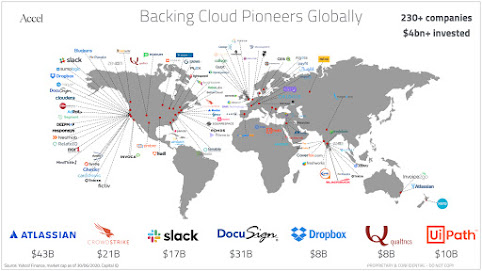
We are very happy to see UiPath, as a European company, join the Accel Cloud decacorn family with other leaders from around the world such as: Atlassian, Crowdstrike, Docusign, Dropbox and Slack. 


At Accel, we love SaaS and Cloud and have invested close to $4B in 230+ companies globally. We believe that category-defining companies are founded all over the world, and while the first Trillion dollars of cloud market cap has come mostly from US-based companies, we expect the next Trillion dollars to come from many hubs across the globe. These smaller hubs can shape companies with growth-oriented DNA because their founders are required to think beyond their local (often smaller) market to plan for a global business from day one. While Silicon Valley will remain an epicenter of technology innovation, we expect to see an acceleration of cloud entrepreneurship globally, following in the steps of UiPath in Europe, Freshworks in India, Xero in New Zealand and  Atlassian in Australia. 


Big congrats and thank you to Daniel and his team for this great success and for what it means for the European and global tech ecosystem, and we look forward to continuing our small role in supporting their journey.


__________________________________

“I want a robot for every person”

Daniel Dines, founder UiPath

__________________________________


***********************


Tuesday, February 12, 2019

Meet Chainalysis, the startup that brought down the biggest dark web marketplace


This post was written with my colleague Amit Kumar. We worked closely together on this exciting new investment.
 
*****************
 
While still very much in its infancy when it comes to development and adoption, a decentralized financial system has the ability to be massively disruptive and important for decades to come. However, in order for cryptocurrency to achieve this potential and for the industry to mature, there is a growing need for foundational infrastructure and regulatory frameworks to drive compliance and transparency between all stakeholders.
 
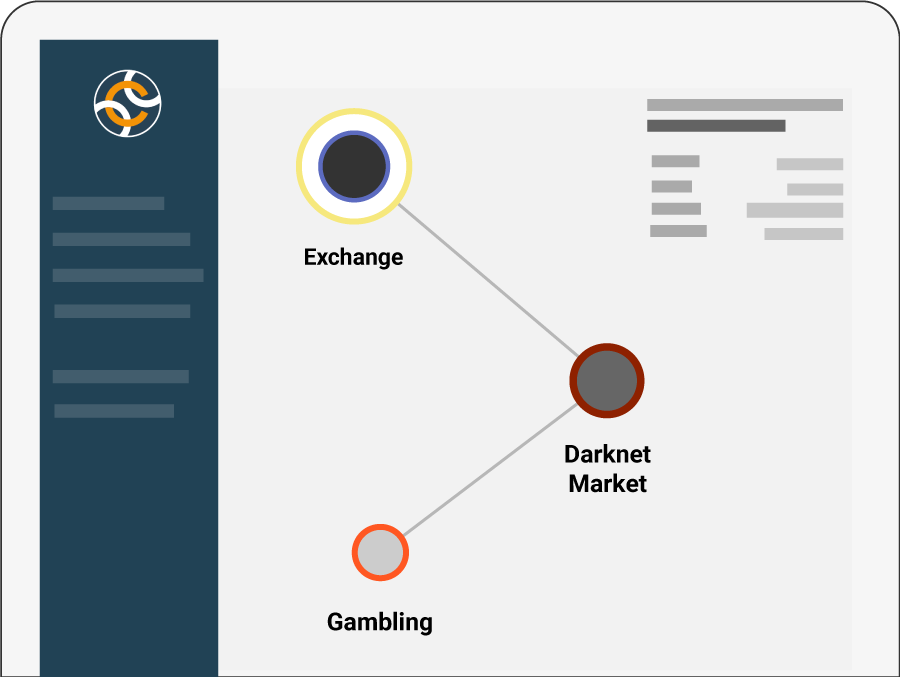
This is why we’re so excited to announce our investment in Chainalysis, a company that uniquely leverages deep analytics and machine learning to help law enforcement agencies track illicit crypto transactions and financial institutions comply with anti-money laundering rules — important pillars towards the inevitable maturation of the cryptocurrency space.

Chainalysis is the clear market leader in their vertical and sits at the nexus between crypto exchanges, financial institutions, regulatory bodies, and law enforcement agencies. They’ve earned this position by their incredible work and track record over the last few years helping law enforcement agencies cope with the rise of this new technology.

While there’s been a number of highly publicized examples including their role in helping creditors of Mt. Gox track down hundreds of thousands of Bitcoins to the Dutch police crediting the company with helping them find Hansa, one of the world’s biggest dark web drug marketplaces, to the company’s more recent Crypto Crime Series published earlier this year, much of the work that they do remains behind-the-scenes, but is no less critical.

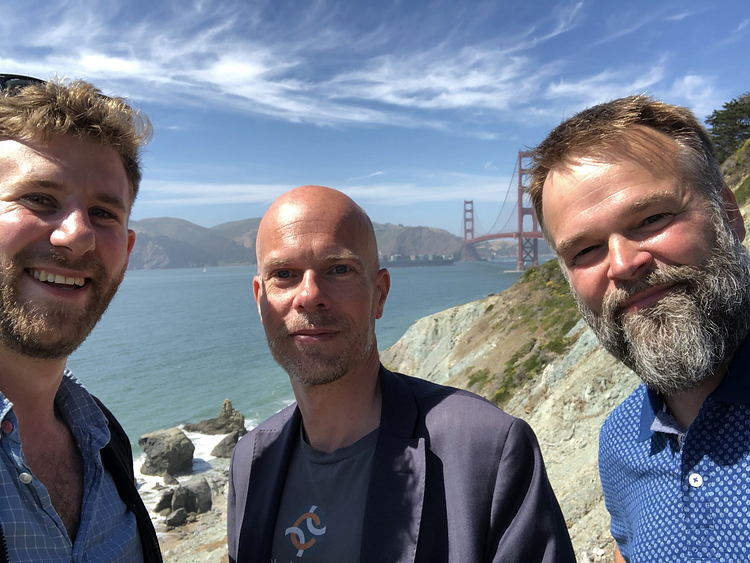
Technology innovation outpacing governments’ and regulatory bodies’ ability to adapt isn’t a new tale; we’ve seen it play out across many different industries in Silicon Valley. And it requires an exceptionally thoughtful, committed team working diligently to close this gap. Michael, Jonathan and Jan have done just that and have quietly assembled one of the very best teams in the space across their offices in Copenhagen, London and New York . We believe deeply in Chainalysis’s mission and couldn’t be more thrilled to help accelerate the deeply critical work that they are doing to bring cryptocurrencies closer to mainstream.


Tuesday, September 19, 2017

Cloud Europe 2017: The Factory is Cranking

Recent SaaS trends and the Accel Euroscape of the 100 most promising companies in Europe and Israel

************
This article was co-authored with my colleague Pia d'Iribarne and published initially on Tech.eu. Findings were presented at Cloud Europe, an Accel and Salesforce event gathering the top 100 SaaS companies in Europe, in conjunction with SaaStock 2017. You can see the full presentation here -

************
Europe is fertile ground for Software-as-a-Service (SaaS) companies, as shown in our comprehensive look at SaaS last year, “SaaS Wars – Europe Awakens”. Since then, momentum has only accelerated, and we’ve published a fresh edition of the top 100 European SaaS companies in conjunction with SaaStock 2017.

But, first, let’s take a look at the overall health of the SaaS industry.

12 cloud IPOs in the past 2 years: One from Europe 

SaaS companies are thriving in the public markets, with their aggregated market cap grew 350% since 2011, and 12 cloud companies going public in the past 24 months. These 12 have performed well, with an aggregate $2.6 billion in revenues (growing 39% year-on-year) and $25B of market cap. Compared to Salesforce, the industry leader, the stats were not too dissimilar over the same period: its market cap grew by $19B and its revenue increased by $3.3B.

Looking closer at the 12 companies, we can conclude that it takes a $100m+ revenue run rate and 30-50% growth to go public in the current environment, even if several companies like Atlassian and Cloudera waited to reach $300M+ revenues before going public. However, the companies’ annualised free cash flow showed a big variation, ranging from -$100M for Box and Cloudera to +$100M for Atlasssian.


 Out of the 12 IPOs, Mimecast is the only company from Europe. However, as Europe’s SaaS acceleration began in 2013, and given that the median time to IPO from this group is 10 years, it will take time before we see a meaningful geographical change in SaaS IPOs. 

A healthy funding environment and momentum in Europe 

Like the public market, the private funding environment is still at an all-time high in 2017 with an annualised investment rate of $8.4B in the US, $2.6B in Europe and $0.9B in India. Europe and India are growing particularly quickly, and investment more than doubled from 2015, while the US is up 20%. 

The pace of SaaS company creation in Europe is growing even faster, up from 200 companies in 2008-10 to 670 in 2014-16. Our investments in the space have followed suit. We’ve invested $2.3B in SaaS companies globally. In 2010, 4% of this funding was going to European SaaS companies, while it’s over 40% this year.

With a more mature SaaS market and more late stage companies, the US is posting record late stage funding rounds with Dropbox raising $600M, Slack $200M and Qualtrics $180M in the past 18 months. Funding in Europe is healthy but reflects the market’s earlier stage. The largest rounds include Algolia with $53M, Collibra and Showpad with $50M each and CallSign with $35M.

The Accel Euroscape

With a positive environment fuelling the market, this year we extended our research for the Accel Euroscape, the 100 most promising SaaS companies, to look at over 1,000 companies across 12 countries and included a new category, Security:


Note: to create the list, we ranked each company by a set of criteria including market attractiveness, level of technology differentiation, strength of the team and initial traction (monthly recurring revenues and growth in number of employees). Nothing is perfect, and we might have missed some great companies. Your feedback is welcome!

Overall, these 100 companies illustrate how the European market is maturing. They have raised $3.4B in total, of which $1.8B or 53% was in the last two years alone. Close to 60% of them have raised more than $15M, and 22% have raised more than $50M, including Algolia, Collibra, Doctolib, Qubit and Showpad. From a revenue standpoint, 58 companies have already crossed the $5M per year mark and 29 are $15M+.

From a geographic standpoint, the UK and Israel lead the pack with 20 companies each, followed by France with 18 and Germany with 8. The remaining companies are fragmented across Europe, showing that great SaaS companies can emerge from any city on the continent. From a funding perspective, Israeli companies have raised on average more than their British (-48%) and French (-160%) counterparts at similar stages. 

Comparing the list to the top 300 leading SaaS companies in the US, some interesting trends emerge:
  • Europe is showing strength in data/ analytics and security, driven by the booming ecosystem in Israel but is less represented in developer/infrastructure and vertical applications.
  • The EU/US funding gap still exists, especially at the seed stage ($1-2M raised on average in Europe vs. $5M in the US) and series B ($20M raised on average in Europe vs. $37M in the US).
  • In terms of funding efficiency, leading European companies appear to be more efficient than their US counterparts. We looked at capital required to reach $10M Annual Recurring Revenue and saw that European companies required $7-15M to get there while US companies required $15-20m.
  • In addition, fast-growing US and European companies are reaching $10M in revenue in similar time periods. Whether Algolia or Twilio and Duetto or Doctolib, they took 1-2 years.
EU Companies: Blue Lines - US Companies: Black Lines

Crystal ball: What the future holds

With the European SaaS landscape moving fast, we’ll continue to see it evolve and believe there are five trends that will define the next crop of fast growing SaaS businesses:

  1. AI and Automation-driven productivity: The next generation of AI-driven technologies to improve backend processes is now coming of age, and is seeing fast adoption from Fortune 500 companies redesigning their processes. Large System Integrators are developing dedicated practices to drive this change. Promising companies in this segment include Robotic Process Automation vendor UI Path and process mining software startup Celonis.

  2. The rise of the SMB engine: The past few years have demonstrated that companies focusing on the SMB segment can become very valuable businesses – both as public companies, with Shopify reaching $10B market cap and Xero, Wix and Hubspot in the $2-3B range, or through M&A, with Netsuite acquired for $9.3B, Constant Contact for $1.1B and Intacct for $0.85B.

  3. APIs and Microservices-driven infrastructure: Given the increasing need for agility and scalability, micro-services and APIs are taking over infrastructure, and we can expect more companies to emerge in this area, providing API-driven functionality (like hosted search engine API Algolia) or helping to manage this next generation of infrastructure (like Application Performance Management solution Instana).

  4. Vertical applications: With the SaaS market in Europe maturing, we expect to see this category develop, and a new generation of services driven by mobile and AI to emerge, such as Shift Technology in insurance, Doctolib in health, Mambo in finance and Mirakl in retail.

  5. Compliance and security: With cyber threats on the rise, the need for security and compliance platforms has never been so acute. One of the challenges businesses face is how to enforce security without complicating the ease of use to the point that it becomes a hindrance to productivity. One pioneer is CallSign, which has developed an adaptive authentication platform, getting rid of passwords.